Abra
Cover
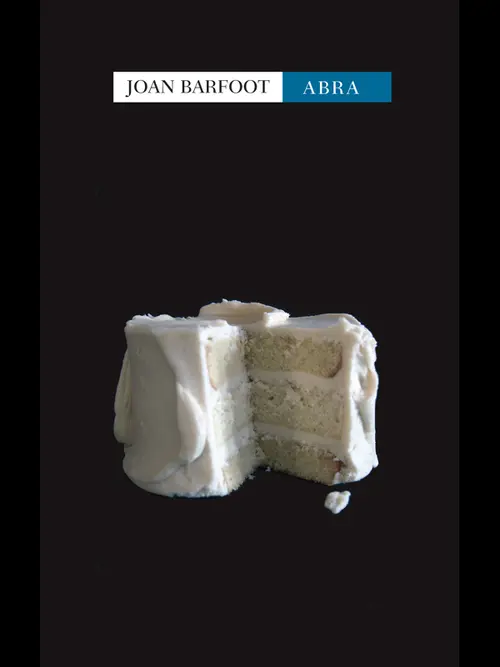
Abra
Title Page
Abra
A novel by Joan Barfoot
Copyright Notice
Copyright © 2012 Joan Barfoot
This edition copyright © 2012 Cormorant Books Inc.
No part of this publication may be reproduced, stored in a retrieval system or transmitted, in any form or by any means, without the prior written consent of the publisher or a licence from The Canadian Copyright Licensing Agency (Access Copyright). For an Access Copyright licence, visit www.accesscopyright.ca or call toll free 1.800.893.5777.
The publisher gratefully acknowledges the support of the Canada Council for the Arts and the Ontario Arts Council for its publishing program. We acknowledge the financial support of the Government of Canada through the Canada Book Fund (CBF) for our publishing activities, and the Government of Ontario through the Ontario Media Development Corporation, an agency of the Ontario Ministry of Culture, and the Ontario Book Publishing Tax Credit Program.
ePub ISBN 9781770862715
Kindle ISBN 9781770862722
Abra
Abra
1
1
My name is Abra.
My name is Abra.
I had almost forgotten that; the naming of things lost its importance here, with no one to hear them named.
And so, until just now — you see I am remembering time as well — “Abra” was gone. Now she is here again, as are so many other things, memories, and I do not know any longer. I thought the struggling time was over. I had forgotten it. I had forgotten so many things.
Abra. An odd name. Today I have said it over and over, making the sounds, making it disintegrate into nonsense. The harsh “A” at the beginning, sliding away into softness. Abra. That is my name; it is what other people have called me. It loses its meaning with repetition. My name. Abra.
2
2
It should have been obvious one of them would turn up, one day. I am glad, though, that I did not think about it. It would not have helped.
The girl is pretty, very pretty. I can see her clearly from the garden, where I have been thinning the lettuce, checking growth, weeding; I do this every day, and it is going to be a fine season. She is walking slowly toward the cabin — is a car waiting for her somewhere, or can she have walked all the way from town?
She seems a very pale person, but then my own hands working among the plants are now so brown that I cannot really be a judge of pallor. She doesn’t notice me squatting in the garden. I imagine she knocks very softly on the door, for she looks timid. I consider, at first, staying where I am, waiting, quiet, until she leaves. But she looks around and her face is frightened, so vulnerable, I think I must do something, for I am strong and think it can do no harm. I stand, brushing soil from my hands, wiping them on my jeans, wondering how to approach her so that she will not be more frightened.
I think to call out to her first, gently, not to startle her, because she looks so much like one of the deer I sometimes see here, senses darting, alert for signals of danger. But after so little use, because I have never become a person who talks to herself, or to animals, or to plants, my voice refuses to be normal. “Can I do something for you?” I call softly, but my voice cracks and comes out, I know, gnarled, maybe menacing. She is startled, whirls to see me and stares. I feel badly. I have tried to keep people away, but I have never tried to frighten anyone. It is sad to see someone look at you with fear.
The words are better the second time. I clear my throat, smile, carefully put down my hoe and begin to walk slowly toward her. I wish for something in my hand to offer her, a piece of food, a gift.
“Can I do something for you?” I say again. She is watching me. I approach her slowly, slowly, giving her time to realize my kindness, my lack of will to hurt her. One must do that here with the animals. The things of nature are filled with mistrust.
She watches me still and waits. She does not bolt, the way some animals still do, although I have been here so long. Her face puzzles me, for it looks as if she wants to run, there is a wariness, and yet there is determination too, and she will not run. Closer, I think she looks ill, and I wonder where she has come from. I feel no welcoming; but also, and I am surprised at this, I do not especially want her to go away. I cannot say why.
I stop a few feet from her. She must say now what she wants, give me some sign, for I cannot go further. We stand silently looking at each other. Several times her mouth moves as if she will begin to speak, but each time she swallows back the words. I think I do not look unkind, although I do not know what she may see in my face.
Until finally: “Are you Abra Phillips?” Her voice is very soft, girl-like and high, trembling a little as if it is not her real voice but has just appeared, like mine, unrecognizable to her.
The words mean something to me. Somewhere in my mind, “Abra Phillips” is familiar, and I consider it. “Are you Abra Phillips?” Am I? I think, finally, that I must be; there is no one else to connect with the name.
“I believe I am,” I answer. I say it judiciously, for that is how I have weighed the answer, but she steps back a pace, and her expression tightens. I am puzzled; what is Abra Phillips that this girl, this slim person with large eyes, staring, should be so threatened?
Again there is silence. I cannot think how to reassure her; it does no good to say, “Don’t be frightened. There is nothing to be afraid of.” The things of nature have to learn that for themselves. They take no one’s word for it.
“Do you know who I am?” she asks at last, almost whispering, sounding older that way, not so girlish.
I do not know who she is, and now I, too, feel uneasy. Should I know? I feel pressure from her, an expectation that makes me uncomfortable. I recognize nothing about her, cannot recall meeting her, am sure she can be no one from the town. But still, and again I cannot say why, it seems important to be polite.
“No, I’m sorry, I don’t recognize you. Have we met?”
“A long time ago, yes,” and she looks at me, hopeful. “I suppose you might not recognize me now. I’m Kate.”
It is evident that she expects me to know her by that, and to make some response. But I do not know her, cannot imagine what she wants from me, resent this unspoken burden of hers. I feel the beginnings of anger, for this is my place. I want her now to leave, and I am abrupt.
“Please go away,” I say. “I don’t know you, I think you must have the wrong person. I do not know anyone named Kate, I don’t know what you want from me. I can’t help you.”
I start to turn away. The sun is very high, very hot, and I want to work in my garden, to pull the cool earth from underneath and spread it around my plants, to dampen and comfort them. In such heat they can feel burned.
But she does not go. I can feel her standing there still, watching me, and then I hear her begin to cry. Even so, or especially so, for I can think of nothing I can do about her pain and I want to be away from it, I do not turn back. I am still moving slowly, carefully away, when she speaks again.
“Kate, Mother,” she says. “I’m Katie. Your daughter. I’m your daughter. My name is Kate Phillips.”
I stop, but I do not turn back to her, not yet. Daughter? Someone from so far away, so far back that the time she comes from is no longer with me? A daughter. I consider the word, a strange word; I roll it in my mind, explore what it means, and finally I remember “daughter”; it is child. A nine-year-old, very thin, with enormous eyes, like this young woman who is here now. Daughter was that little girl. Can this person also be daughter?
I turn to consider her again. The eyes, yes. The slenderness yes also, although this person is not thin in the same way as the nine-year-old. Not a child’s face, though, not the daughter’s face at all. Much older, not lined, not older like that, but somehow tired. Not fresh, like the daughter’s face. They cannot be the same person, the daughter was someone else altogether, a child. I have not thought about her for a very long time, and this person has no right.
“No,” I say strongly, my voice supporting me this time, giving me timbre and strength and harshness. “No, you are not my daughter. I remember her, and she is not like you. Go away now.”
She does not move. Her face is rigid, hurt and determined both, and it will not be so easy. I wish that I had kept the hoe; not to hurt her, but because I feel defenceless, naked, standing here against her.
“I’m sure I don’t look the same, of course.” There is a strain, as if she is making her voice reasonable against its will. “I was nine years old. Now I’m eighteen. You can’t expect me not to have changed. You’ve changed too. I didn’t recognize you at all at first.”
Time. She was nine. Now she is eighteen? Nine years? It is possible, I admit. It is certainly possible that it has been nine years — it may have been twenty, or eternity.
So. Granted that it is possible, I still have perhaps a choice about whether or not to recognize her? Her body seems to be leaning toward me, and her face is concentrated on mine, willing me to accept. Her persuasion is silent and powerful, but I have to resist. I want to tell her again to go away, to refuse her. I can see more clearly now the nine-year-old in her. The hair, the hair has deepened, not so much red in it now, and not so soft. Waving, very beautiful, not curling and short as it used to be, so easy to run hands through when walking by the child. I had thought reddish hair would be coarse, but hers had been soft. Now it seems thicker, less delicate.
More flesh, on the body and the face. Her bones used always to be there, a hug was sometimes painful if bodies combined at odd angles. Now there would be no pain, even the bones of her face more covered.
Only the eyes are the same. Very wide, very brown, intent, serious. With that signal behind them, asking not to be hurt, that was there at nine, before anyone had considered hurting her. She was a child who seemed, already, to know many things.
I know her now, and it locks me to her.
“I’ll make tea,” I say, starting toward the cabin. Knowing, I cannot act against her, but I hope she will choose the other way, run back to the city and her home, wherever it is; but no, she follows me. I suppose there can be no choice now, for either of us. So many things have been like that.
I put on the kettle while she sits at my old round wooden kitchen table. I find a second cup, packed away on a high shelf, and although she is taller than I, she does not offer to reach it for me. She is still frightened of me, wary.
I am not used to being watched. I am clumsy with the tea, pour it awkwardly. I feel I am being asked to perform, to be someone for this person who is daughter. There is a familiarity about the feeling, a sensation shooting back into memory, although I can’t say precisely where it was before. There is nothing to do then but sit down, so I do, heavily, longing for something different, wanting to be peacefully back in the garden, alone. She is looking at me, sad, expecting something. What?
“Why are you here?” I ask finally. There seems to be a rhythm missing from the question, as if I should soften it by asking it again in a different way, but I leave it as it is.
“I’m old enough,” she answers. There is a pause, as if she thinks I will understand that. She is holding her cup with one hand, running the forefinger of the other hand around and around the edge at the top, looking down, watching the finger as if it explains everything. Finally she goes on.
“I wanted to know where you’d gone. I wanted to know why it happened. Daddy said to wait, he said to leave you alone because that was what you wanted, but I’m old enough now, I figure I have rights too, and they’re as important as yours.” This last is defiant, hostile, as if I might disagree and say she has no rights. But then, what else would she think, after all?
“It was hard to find you,” she continues. “Daddy wouldn’t tell me anything. It took me six months.” She glances at me, asking me to appreciate her investment, her effort.
“I’m sorry,” I say. “It never occurred to me that you would want to find me.” I shrug. “I guess I assumed too much.”
“Just what did you assume, Mother? What did you think you knew about us?” She is openly angry now, not frightened, but there is pain in her voice. “What the hell would ever make you think I wouldn’t go looking the first moment I could for a mother I can hardly remember? I wanted to know why you left me. That’s all, just the reason why you left me.”
Stupidly, I can see, that surprises me, for I haven’t understood how far apart we must be. She has taken it all personally, and it wasn’t personal at all. Of course, in many ways she must still be a child, but I react fiercely against her anyway, protecting myself.
“Why do you assume I left you?” I ask, and she looks frightened again. “I didn’t leave you. You had nothing to do with it. It was just me.”
When she speaks again it is more calmly, with control.
“Then why did you go? If I wasn’t important, and Daddy and Elliott weren’t important, why did you go then? There must have been reasons.”
“I don’t know. I don’t recall. I think there weren’t really reasons.” I pause. “You’re eighteen, you say?”
“Yes.”
“Then you’ve survived. Why don’t you leave it at that and go on with what you have? That’s the point, surely?”
Words are coming slowly, with great difficulty. I want to be emphatic, to make her go away, but I am not sure enough. It has been so long, there has been no need for words for such a long time; even my thoughts no longer seem to use them, but are sensations, flashes in the mind, and the remembering of words and the actual execution of them, forming my tongue and lips and throat so that they come out and can be recognized is an effort, and every part of the process must be painfully considered before a proper sound will emerge. I have not realized until now how far away from it all I have fallen. There has been no need to realize.
It is an unaccustomed exhaustion, a tiring intrusion. I stand suddenly, deliberately forgetting that this person opposite me, whose head snaps back as I rise and whose eyes draw away into themselves, is still afraid of me, wants something from me, is terrified of receiving nothing. I move swiftly, harshly, to the door and out of the cabin. I need to put things back, feel myself free again. The sun is still beating down, almost directly on my garden; such a very few moments have passed. The hoe is still lying beside the rows of tiny corn plants. I want every moment for my work, the summer will go quickly and there is much to be done. I pick up the hoe and start weeding again, harder now, attacking the low-lying green plants that threaten, every year, to choke my food. I behead them, dig up their roots, and then I feel vengeful, regret having injured them when, if they must be destroyed, it is better to do it with gentleness. I become calmer, concentrate on digging them out carefully, just tiny baby growths, offspring, perhaps, of ones I have already taken away. I place them at the ends of the rows of corn, just three long rows this year, most of the cobs for freezing for the winter, and leave them to be picked up when I finish.
I think of the corn, when it is grown and giving food, and the soft silk surrounding the cobs, and I recall again the softness of Katie’s hair, the daughter of nine years; and then I remember the young woman in the cabin and I can feel her waiting, the pressure of her waiting. But it isn’t time yet to go back to that, my anger rises again at the remembering.
The plot of corn is finished, and I gather the weeds, there are only a few, and place them in a basket. I carry them to the compost heap, add them to the pile, turn it over. Rotting goes on swiftly there.
The cabbages will have worms again. Every year the cabbages are almost useless, and yet every year I try them again, and never learn what to do about them. But the tomatoes and the green peppers are doing well, and many of them, like the corn, I will freeze for winter. I have never been able to freeze vegetables so that they taste in any way fresh, but in the winter I need food and I eat what I have put away for myself, knowing that at least it is nourishing.
Occasionally while I move among the plants, crouching, checking them, for it is vital to me that the garden be good every year, I stand, bending backwards slightly, my hand in the small of my back to ease the ache. I am no longer young; I can no longer assume that the parts of my body are in good order. I never go to a doctor, but I can feel things breaking down gradually, so that one might never notice if it were not so important to keep track of these things. When I stand I raise my face to the sun, because it is good to consume it while it is so intense.
The last time I stand and turn myself toward the light, I see the young woman again. She is standing now on the porch, watching me, looking into the sun but not shielding her eyes, so that she must only see the shape of me. Her arms are at her sides, her shoulders hang loosely, as if she has admitted defeat.
“Good,” I think. “Now she’ll go away.” I bend again over the plants. There is lettuce enough for a salad for my dinner; just for mine.
She has come up behind me and is standing there when I rise, holding my handful of lettuce. I am startled, and that combined with the sad and silent way she watches me makes me angry again.
“Well?” I ask shortly.
“Do you want me to leave?” Her voice is high again, young and tense. My anger slips; I cannot hold it. I cannot put my finger on what it is about her that defends her against me. But there is some — bond. Why can I not understand?
The struggle and the confusion are beginning now in earnest; I sense the danger, but I cannot order her away. I can, at most, be brusque.
“You’ll have to do what you want. I won’t invite you to stay, but I can hardly make you leave. There is a hotel in town. You must have gone past it, getting here. I live alone. I don’t think I can help you, truth is something I don’t know much about, and if it’s explanations you want, I can’t give you any. In the end, you know, you’ll have to go away and do whatever it is you do in any case.”
I am harsh. I am not accustomed to giving. What she wants is something I long ago became incapable of being. It has been much too long to try again.
The Story Continues on BooksBarbecue!
Enjoyed this preview? ❤️ Do not stop here!
Read the complete book free online → 🔗
Continue reading now on BooksBarbecue and discover every page!
Love reading? Bookmark BooksBarbecue.com for more amazing books!
Happy Reading!