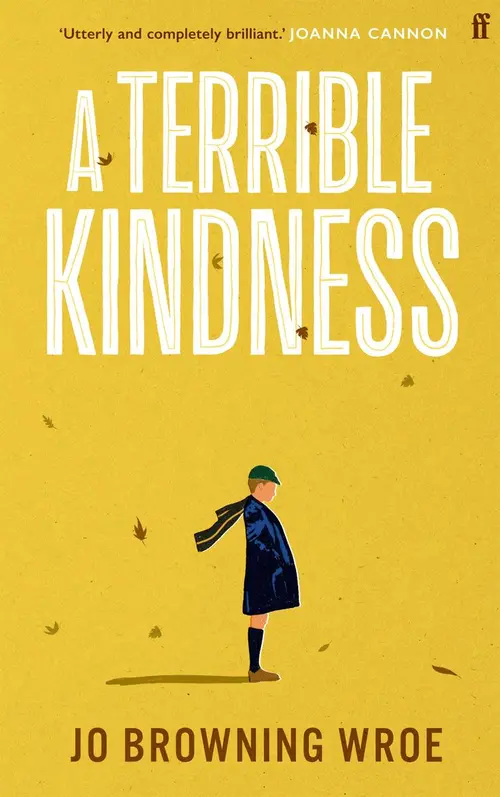
A Terrible Kindness
Landing Page

Jo Browning Wroe
A TERRIBLE KINDNESS

Dedication
For the embalmers who went to Aberfan and for the people they went to help
Contents
- Title Page
- Dedication
- Part I: Aberfan
- 1
- 2
- 3
- 4
- 5
- 6
- 7
- 8
- 9
- 10
- 11
- Part II: Cambridge Choir
- 12
- 13
- 14
- 15
- 16
- 17
- 18
- 19
- 20
- 21
- 22
- 23
- 24
- 25
- 26
- 27
- 28
- 29
- 30
- Part III: Family Business
- 31
- 32
- 33
- 34
- 35
- 36
- 37
- 38
- 39
- 40
- 41
- 42
- 43
- 44
- 45
- 46
- 47
- 48
- 49
- Part IV: Midnight Choir
- 50
- 51
- 52
- 53
- 54
- 55
- 56
- 57
- 58
- Part V: Aberfan
- 59
- 60
- 61
- 62
- 63
- 64
- 65
- Acknowledgements
- About the Author
- Copyright
Part I
ABERFAN
1
OCTOBER 1966
Something dreadful happened in Wales yesterday, but it was William’s graduation and so he has been distracted. He left the Thames College of Embalming with outstanding and unprecedented results. Tonight is the annual social highlight for the Midlands Chapter of the Institute of Embalmers; the Ladies’ Night Dinner Dance in Nottingham. To celebrate William’s success, and equip him for his first social highlight, Uncle Robert has bought him a dinner suit and a bow tie. Aged nineteen, William is a little excited, but mostly terrified by the news from his uncle that their president, David Melling, is going to ensure that a fuss is made of him.
Fifty miles from home in Birmingham, William will spend his first night in a hotel; the Lace Market, along with Uncle Robert and his business partner, Howard. Sharing a table with them are the Strouds, an undertaking family from Solihull, and on William’s left, the only other person his age, Gloria Finch, also from an undertaking family, with whom William lodged during his year at college in Stepney. Glorious Gloria, whom William has loved from their first conversation a year ago, drinking cocoa in the Finches’ cosy galley kitchen, while her parents watched telly in the lounge. Tonight, she’s wearing a tight black dress with sequins, through which her whole body seems to be winking at William.
‘Swanky’ is how Robert described the event to William, and he wasn’t exaggerating. The bright, trussed figures of the women, with sparkling necks, wrists and fingers, are vivid against the men’s solid black and white – though Howard’s cufflinks are sparkly too. Howard loves an event; loves a fancy do. He helped to choose William’s dinner jacket and dicky bow, and stood behind him to demonstrate tying the tie, his broad cheek, brushing occasionally against William’s face, making them both giggle.
William takes in the ballroom’s high ceiling, the pink and white embellishments, looping and twisting in and out of the alcoves. Giant diamond teardrops and swooping strings of chandelier glass hang imperious and heavy over the tables. There may be more knives and forks on either side of William’s plate than in their entire cutlery drawer at home – he must work from the outside in. The knife is heavy, the white linen napkin that he unfolds and puts over his knees surprisingly stiff.
It’s been a while since William has seen such dressed-up tables and people. Not since he was a boy chorister in Cambridge and sang at Formal Hall, or one-off special occasions. He quickly pushes the memories away, but not before registering a difference. Even as a ten-year-old, William understood that those seated at high table hadn’t arrived, they’d always been there, and opulence was no treat. Tonight’s excitement is palpable, so too the satisfaction of these embalmers who have earned an evening of opulence, a reward for their dedication to exacting, important work; the work of their grandfathers, their fathers, and for some, their sons.
After the hard graft and study of the last year, William is happy to take his place in a world in which you do a difficult but honourable job to the very best of your ability, most of the time for little reward beyond your own sense of satisfaction. But every now and then, you get to pat each other on the back and go swanky.
The fish soup is salty, but delicious eaten with the dainty roll he’s daubed with curls of ridged butter. William is using the perfectly round spoon, tipping the bowl away from him when he gets to the bottom. He notices that Gloria is watching him, beaming her warmth through her lively green eyes.
‘I’m glad you came,’ he says quietly.
‘I’m glad you asked me.’ She grins, and holds his gaze long enough to let William feel he can gently rest his leg against hers under the table.
The roast pork, crackling and apple sauce move from William’s plate, to his mouth, to his stomach easily, and it makes him happy to see Uncle Robert’s bright-eyed enjoyment of the evening. But during pudding, he notices David Melling at the top table patting his breast pocket and removing a piece of paper, which he unfolds and looks at over his glasses. The jam roly-poly expands in William’s mouth. The weighty cutlery slides in his palms.
Gloria glances at the top table then back at William and slips him a wink. ‘Get ready for the fuss,’ she whispers, leaning so close he feels her breath on his ear and smells her perfume. They joked earlier about quite what that would mean. Gloria thought they might sing ‘For He’s a Jolly Good Fellow’, and William, desperate to appear nonchalant and funny, said he hoped they’d stand him on a very high pedestal and bow down.
Howard takes a cigarette from the bowl on the table and lights it, as does Gloria. William, who still considers his lungs the most precious part of his body’s architecture, even though he hasn’t sung for five years, has never considered putting one to his mouth. Yet there’s something appealing about the bluish wreaths of smoke winding through the banquet hall – a communal breathing out and relaxing. As coffee is poured from skinny silver pots, people lean back in their seats. William wants it over and done with. He sees Uncle Robert look to the top table and then at William, giving him a small nod.
2
‘Ladies and gentlemen, I hope you’ve enjoyed tonight’s feast.’ David Melling smiles. ‘And don’t you polish up well!’ He brandishes a piece of paper. ‘I have my dance card here, ladies, though you may have to form a queue, so please be patient.’
Once the laughter dies down, Mr Melling talks, William notes, for eight minutes and ten seconds about the continued high standards of the institute, its charity work, its growing international reputation. William resists wiping the sweat at the back of his neck.
‘But now,’ their president says, putting the card down, clasping his hands in front of him, ‘closer to home. In a profession largely family-run, though it’s frowned upon nowadays to put pressure on the next generation, it is, nevertheless, a heartening and happy circumstance to hear of a young man not only taking up the baton, but winning gold.’
Gloria raises her eyebrows at William. ‘Bring on the pedestal,’ she mouths. Uncle Robert grins at him. His throat catches. ‘Our longstanding member, Robert Lavery, of Lavery and Sons, is, I know, a very proud uncle this week.’
The idea of everyone looking at him is suddenly intolerable. William wants to run. He can’t, for Uncle Robert’s sake. Not again. He must force his mouth into a smile, calm his eyes. The thud of his heart is so aggressive he’s sure if he looks down, his shirt will be punching outwards.
‘Young William Lavery graduated from the Thames College of Embalming this week, not only making him the youngest embalmer in the country …’
William stares at the floor. Will he have to stand? Should he wave? Bow? Say something? David Melling has stopped talking. William studies the hectic yellow and orange swirls of the carpet, the spiked breadcrumb near Gloria’s stiletto. Why has it gone quiet? He forces his head up. A waiter has handed Mr Melling a piece of paper, which he is now reading.
‘Thank you,’ he says to the man, who is leaving through the tall double doors of the ballroom.
The hush is like a scream. Uncle Robert is frowning. David Melling’s moustache glistens under the chandelier as he stares at the pink piece of paper.
‘Apologies.’ He holds it up briefly. ‘This is a telegram from Jimmy Doyle, Northern Ireland Chapter, and I’m afraid it requires our immediate attention.’ William’s eye is caught by Uncle Robert shuffling in his seat, disgruntled. ‘So, many congratulations, William Lavery, for being the first student to achieve full marks for every piece of work, both practice and theory,’ continues Mr Melling with a surge of good cheer, propping the telegram against a small vase in front of him. ‘Let’s give him a big round of applause.’ William stares at his crystal glass, smiles, nodding his head a couple of times. Sweat dribbles into his left temple. Gloria pats his knee under the table. ‘We expect great things from you, William.’ He pauses then reaches for the telegram. ‘But sadly, we have another important matter to consider. It concerns the tragedy at Aberfan yesterday, of which you will no doubt have heard.’ He reads aloud. ‘“Please share with gathered institute members.”’ William sees thin strips of David Melling’s scalp shining through his brilliantined comb-over. ‘“Embalmers needed urgently at Aberfan. Bring equipment and coffins. Police blocks surround village; password Summers.”’ He lays the telegram down and stares at it for a second. A cold creamy smell wafts up to William; the custard sitting in his bowl. ‘I suggest, gentlemen, those who feel able to answer this call for help, have a strong cup of coffee and be on your way. The rest of us will try and enjoy the remainder of the evening on your behalf.’
William knows his uncle expected more of his moment of glory, but he is relieved at the sudden refocusing of attention and feels a steadily building resolve in his chest.
‘I want to go,’ he says.
Uncle Robert’s face shows he wasn’t anticipating this. ‘I think they’ll want experienced men, William.’ He glances at Howard. ‘Maybe even with a bit of disaster experience.’
‘They didn’t say that,’ William says. Gloria is watching him.
‘Maybe I should go?’ says Uncle Robert.
‘Your back wouldn’t last,’ Howard says immediately. ‘No sleep, a long drive and then God knows what.’ Howard nods his head at William, but holds Uncle Robert’s eye. ‘The boy’s a wonderful embalmer, he’s stronger than you or I. Let him go.’
‘With respect,’ William hears himself say, ‘I don’t need permission. I’m going.’
Everyone at the table is looking at him – Uncle Robert, Howard, the Strouds, Gloria – but William doesn’t care.
‘Good on you, lad.’ Mr Stroud pats his hands on the table. ‘This says more about you than any exam results. You show ’em!’
Half an hour later, wrapped in his winter coat, William is on the pavement with his uncle. He’ll drive himself and two other embalmers back home to Birmingham, where they will get changed and load their cars with all the kit and coffins their hearses can hold.
‘You’re going to see things you’ll never forget.’ Uncle Robert glances sideways at William, concern all over his gentle face. He turns back and looks straight ahead. ‘You know, your mother’s not far from Aberfan.’ He slides a piece of paper into William’s pocket. ‘You could call in on her.’
‘I can’t. You know that.’
His uncle’s mouth turns down as it always does when they mention her. He breathes in and out slowly. ‘And you know I’ve never accepted that, and I never will.’
3
It’s half past midnight when William leaves Nottingham with his two passengers, heading home along largely deserted roads. Roy Perry, an embalmer from Erdington, reads out reports from the armful of newspapers that the hotel receptionist gave them on their way out.
Just after 9.15 yesterday morning, waste tip number seven on the upper flank of Merthyr Vale colliery, loosened by two days of heavy rain, had slipped and descended the mountainside. Half a million tonnes of coal waste gathered trees, boulders and bricks on its way. It had been sunny on the mountaintop, but foggy down in the small village of Aberfan. So while the tippers had seen the slag start to move, the villagers had no warning that the 40-foot wall of debris was coming their way at over 50 miles an hour. Having laid waste sections of the railway line, a disused canal and a farm, its finale was to rip through Pantglas primary school and two rows of houses.
Frantic parents dug through the rubble with their bare hands. Miraculously, some children were pulled out alive in the first two hours, but since 11.00 that morning, there had been no more cause for celebration. Over 140 bodies needed rescuing.
With water and mud still flowing down the mountain, miners came straight from their shifts armed with shovels. Volunteers flooded the village, clambering over the slurry. Police voiced concern that well-meaning, untrained volunteers were hampering the work of the rescue teams now on site.
The recovered bodies of children were wrapped in blankets and taken to Bethania Chapel, the nearest communal space to the school. The police set about trying to clear off the viscous slurry so the children could be identified, but with no electricity, water or experience, they struggled.
▪ ▪ ▪
Once Roy finishes reading, the three men continue their journey in silence, and soon William’s passengers have settled deep in their seats to doze while they have the chance. He is wide awake, the blood romping through his veins. The treacly black coffee has done its job. Well, the coffee and Gloria.
Each time he remembers what happened, his body responds afresh, as if it were happening to him right there at the steering wheel. Once it was decided that William was going to Aberfan, Gloria stood up and led him by the hand, out of the ballroom and into the lush hotel gardens where she planted a kiss on his surprised mouth. He wonders now if, after the last year, when his reticence has scuppered so many possible moments of intimacy with Gloria, it was his sudden resolution to volunteer that made her want to kiss him.
‘Thank you,’ he said, as the liquefying sensation swept his body, and her hands sat in his without him knowing how they’d got there.
‘You’re welcome.’ She laughed, her eyes so glittery and alive, so hopeful. ‘You daft bugger.’
‘Can we do that again?’ he said, already leaning down towards her magnificent lips, his whole body alive to the thrill of a future filled with Gloria.
▪ ▪ ▪
He reaches Merthyr Vale at 3.35 in the morning, the Lavery and Sons hearse loaded with 30 gallons of formaldehyde, embalming instruments and four child-sized coffins. He’s already passed through two police blocks with the password, ‘Summers’, the largest undertakers in Cardiff. Though his journey has been in the dark, the thick belching chimneys sitting close to the countryside and the narrow lanes tell him he’s in a different country.
There’s no denying the excitement, even though for the last hour each blink has scratched his tired eyes. He feels noble, heroic even, driving through the night on his own, armed with all the skills he’s learned this year. Perhaps disaster embalming is his future. Perhaps the next twenty-four hours will shape his life. When stray thoughts of his mother, physically nearer to him now than for five years, flash through his mind, he bats them away.
For the last half-mile into Aberfan, he’s opened his window to stay awake. The spindly paths are periodically washed with yellow light and he has to pull over to let open lorries pass, humpbacked with glistening heaps. A harsher halo of white light shines above the village like a foreboding star. Now, yet another policeman stands shrouded in a rain cloak, waving him down.
‘Embalmer?’ He glances through the hearse window. Despite himself, William wants to laugh; he sounds exactly like Tom Jones.
‘Yes. Password Summers.’
‘You’ll be needed in Bethania Chapel’ – the policeman leans in closer – ‘where the bodies are being put.’ With a dart of surprise, William realises the police officer is crying. Suddenly backlit by the lights of an oncoming truck, his slick mac turns silver-white. ‘Pull over a minute.’ William edges the hearse onto the verge and the officer waves the lorry on. ‘You’ll see it on your right.’
‘Thank you.’ William engages the clutch, starting to feel the urgency, the need to get on with what he’s come to do.
Aberfan is floodlit and teeming. Men swarm over a colossal, ungainly mound, some in lines, passing bucket after bucket to man after man, until the last one empties it into the waiting lorry. Others are bending and straightening, plunging shovels into the dark mountain they stand on, faces like blackened granite. When William spots the school roof jutting out of the slurry at unnatural angles, he swears softly.
Driving slowly because of all the people, he sees a flat-faced, dreary-looking building with a line of women standing outside, a few sitting on metal chairs. Another policeman is at his window immediately.
‘I’ve got embalming fluid and equipment to unload,’ he says quickly. The policeman stands back and gestures at the piece of pavement directly in front of the chapel and the waiting women. William jumps out of the car, latent energy strong in his limbs. The women stare at him with heavy, dark eyes, and with a flash of heat through his body he realises they are mothers of dead children. He opens the back of the hearse and starts to pull out the formaldehyde, standing the containers side by side. The policeman helps, and a man materialises at his side and does the same. No one speaks.
The chapel door swings open and a man strides out. He looks to William to be in his early thirties, older than him, but much younger than his uncle. He heads straight for the hearse.
‘I’m Jimmy. Jimmy Doyle.’ He doesn’t look at William, but at what he’s brought with him. ‘Thank God,’ he says quietly, when he sees the small coffins. ‘We brought a load from Ireland. The airline even took the seats out so we could fit them in, but they weren’t nearly enough.’
William doesn’t know what to say, so he just keeps pulling the fluid containers from the hearse and placing them onto the pavement.
‘As soon as you’re unloaded, I need you to help in here with identification.’
4
‘Thank you for coming.’ Jimmy puts a hand on William’s shoulder, walking him a few feet away from the gathered women. William’s feet are sticking to the pavement. ‘What’s your name?’
‘William Lavery.’
‘Were you at the dinner dance?’ William nods. ‘It’s pretty basic in there.’ Jimmy has a thick Belfast accent. He’s talking quietly so the women can’t hear. ‘Electricity and water were cut off when it happened. The fire services are doing their best, but for now it’s a hurricane lamp and buckets of water. Doors on trestles for embalming tables.
‘Bodies are brought here, wrapped in blankets. Before we arrived, the police were cleaning them to get identification from the parents. We’ve managed to get the coroner’s permission to treat the bodies without post mortems, thank God. We’ve set up a couple of stations in the vestry and a couple more in the other chapel down the road. We wash them, get them identified, treat and coffin them. Then they’re moved to the other chapel.’ Jimmy still has his hand on William’s shoulder, but he’s talking to a spot on the ground a few feet ahead of them. William tries to concentrate; there won’t be time for questions later. ‘Our biggest challenge is the slurry. It’s like tar and all you’ve got is soap and cold water. Just do the best you can.’ Jimmy rakes a hand through his red hair. ‘Now listen, William – it is William, isn’t it?’ William nods again. ‘The help we can give these people is not complicated. We do our job. We do it well, we do it quickly and we leave. We’re not priests, or friends or family. We’re embalmers. Keep your head down and your heart hard. That’s your kindness.’ He squeezes William’s shoulder. ‘Got it?’
‘Yes, sir.’
‘One other thing.’
‘Yes, sir?’ William wants to get on with it. If he doesn’t start soon, the desire to run might overwhelm him.
‘There’s a concern that more slag might come down. Especially if this rain carries on. If you hear the alarm, you get the hell out. Understand?’
‘Yes, sir.’
‘Right then, let’s go to it.’
They return to the chapel entrance, watched intently by the line of women.
In the chapel gloom, William can just make out cocooned shapes; on the pews, upstairs and downstairs. Compared to the lofty, stained-glassed majesty of his chorister chapel it seems ludicrous that this simple building can even share the same name. They could have as many embalming stations as they wanted in there, and the choir could still practise without getting in the way.
‘The bodies recovered first were relatively intact and most of those have been identified, embalmed and coffined,’ Jimmy says. ‘Now it’s getting harder. That forty-foot pile of slag hit the school at one hell of a speed, so they’re not just covered in it. You can imagine, with that sort of impact …’
William glances round at the blanketed bundles, guessing there must be over fifty. ‘How many more to be rescued?’
‘Don’t know exactly’ – Jimmy walks through to the vestry and William follows – ‘but there were a hundred and sixteen children missing overall, plus adults.’
The Story Continues on BooksBarbecue!
Enjoyed this preview? ❤️ Do not stop here!
Read the complete book free online → 🔗
Continue reading now on BooksBarbecue and discover every page!
Love reading? Bookmark BooksBarbecue.com for more amazing books!
Happy Reading!