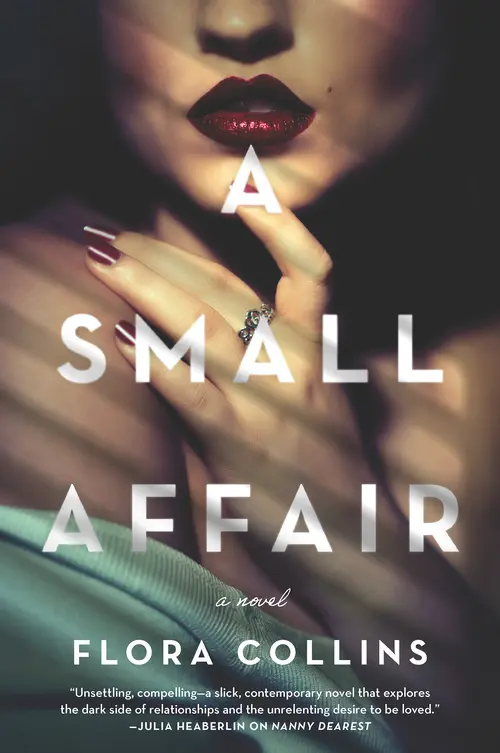
A Small Affair
Cover
Praise
Praise for Flora Collins
“Flora Collins is a sure-handed and inventive suspense novelist.”
—Adriana Trigiani, bestselling author of The Good Left Undone
On Nanny Dearest
“A slick thriller.”
—CrimeReads
“A seesaw of rising tension that ultimately delivers a raw, crashing conclusion… Collins’s debut illustrates the sometimes obsessive and terrifying nature of love and the shattering consequences of its betrayal.”
—Library Journal
“A well-crafted debut… Horrifying… Psychological thriller fans won’t be disappointed.”
—Publishers Weekly
“Unsettling, compelling, elegantly paced—Flora Collins’s debut is a slick, contemporary novel that explores the wispy, nagging memories of childhood, the dark side of relationships, and the unrelenting desire to be loved.”
—Julia Heaberlin, bestselling author of We Are All the Same in the Dark
“A powerful debut about the fine line between love and obsession… Haunting.”
—Miranda Smith, author of What I Know
“You won’t be able to put this book down.”
—Emily Freud, author of My Best Friend’s Secret
Dedication
To Andrew, my best friend and the closest thing I have to a husband. Always and forever grateful that our “marriage” has yet to be tabloid fodder.
About the Author
Flora Collins was born and raised in New York City and currently resides in Brooklyn Heights.
Part One
PART
ONE
1
One year ago
We met on an app, one of those achingly boring, exclusive ones. White text on a black background. Where you have to work in a certain industry, have a certain type of education, a pedigree to differentiate yourself from the riffraff.
Oddly, or perhaps not oddly at all, I remember the exact moment we matched. I was on my couch under a heavy knit green blanket, my legs splayed across my best friend and roommate’s legs. We were watching Real Housewives—though which franchise, I can’t recall—ignoring each other, ignoring the TV. Classic millennials on our phones, doom scrolling.
I wish with all my might I could do that again. Sit next to Quinn on that olive green couch we’d found in a West Village Housing Works and ignore each other without these ghosts separating us, sitting on my chest. Incapacitating me. Incapacitating all my relationships.
“Ugh, can you move your legs? Mine are asleep,” Quinn whined, throwing his end of the blanket in my face and getting up on unsteady feet, stretching. He padded across to our small kitchen and took out a beer, watched me on my phone, my face lit by the glare of the TV.
I looked up. “Want to help? I’m back on the apps.” Quinn set his beer down and clapped his hands. Quinn didn’t date much. He’d been on and off with his partner, Sam, for seven years now, since we were sophomores in college. Right then they were off, had been off for the past six months or so. I knew it would only be so long until they got back together; they rarely dated other people. It was like they were actually meant for each other.
But he loved to live vicariously through me. Loved to vet and interrogate all the guys who had come home with me over the years, commenting on their clothes, their hair, their smell, their faces, forcing me to tell every minute detail about the sex, the morning after, whether they snuggled me up close at night. Whether they followed my instructions in bed, asked what I wanted, needed.
So I wasn’t surprised when he plopped back down on the couch, grabbed my phone away from me and began to swipe.
“All these people have liked you?” he asked, eyes roving over the screen. I nodded. “Damn, Vera, you haven’t been on this app in ages, have you? You have like fifty likes.” I nodded again. I hadn’t gone out with anyone in a few months, mostly because of new responsibilities at work. It wasn’t even like I felt incapacitated by those responsibilities; I just had no wish to spread my enthusiasm for work thin. Dating forced me to spread it thin, and if I were being honest, the whole process of dating made me utterly exhausted.
But now I had a handle on everything. I was ready to start anew, begin the process yet again like every other mad straight woman always assuming the next man will be different. And I was bored. I hate that most of all, that I was bored. My whole life in pieces because I didn’t buy a good enough vibrator.
“So you get to ‘like’ them back? And that’s a match?”
“Yes. If you gave me my phone, I could show you.” But it was no use; he was already at it. “You know, we have different tastes. You keep swiping no on people I think are cute.”
But Quinn kept the phone. “Babe, I have better taste than you. Just trust me.” And I did.
In a few minutes he passed back my phone. He’d only “liked” three people back: a tall, built guy with too many selfies. A dweeby-looking dude with excellent education credentials, but barely any neck.
And Him. Tom Newburn. Older, the oldest end of the spectrum I’d set. Thirty-seven—ten years older than I was then. Square jaw. Slicked back, dark hair. Shapely lips. One child. Liberal.
Within minutes, he’d messaged me. And it occurred to me, as my phone buzzed with a notification, that there was no way to tell when he’d “liked” me first, that he could have been waiting for months, since the moment I’d first logged off the app. And just like that, he pounced the moment I “liked” him back.
Are you a fan of Eyes Wide Shut?
And that made me smile, because that was my answer to the prompt “What’s one thing you can never stop talking about?” And I’d said: “Nicole Kidman’s poison-green Galliano for Dior dress from the 1997 Oscars.” It was a cheeky answer for a straight woman to give; it easily filtered out the men who would automatically dismiss me as a “fashion chick” and swipe left.
I typed out a reply. Then deleted it. Typed it out again. Quinn wasn’t paying attention to me anymore; he was back on his own phone. I didn’t want his opinion, anyway.
Yes, but I prefer To Die For if you really want vintage Kidman.
That was the beginning of the end, I guess.
2
Present day
In my mother’s guest bedroom, all I do is sit and think.
Mom never had great taste. And somehow even in this gorgeous landscape, with a view of the mountains, the house itself seems stale and brittle. The cherry-patterned wallpaper is garish, yet somehow faded, though she’s only lived in this house for a few years. The curtains are brown and made of hemp, thin as well as ugly. The kissing swans lamp on the bedside table is one she found at a flea market. One swan’s eye is chipped.
I’m used to staring at her, the one-eyed swan. I hardly leave this room some days and I know she isn’t judging me. Like even my closest friends are.
After all that happened in the city, I needed to escape. I’d grown up in Westchester, a breath away from Manhattan, but when my parents divorced in my early twenties, my dad moved to Seattle and my mom sold the Westchester house and bought this smaller one farther north, in the Hudson Valley.
Mom was almost too happy to take me in. My brothers were long gone—Oliver, living abroad and Theo, in the Midwest. I had collapsed at her feet the moment I stepped over her threshold, choking on the sage she had used to cleanse the house.
She had hugged me, told me it was all going to be okay, patted my cheek, sprayed my pillow with lavender for a good night’s sleep. And it worked.
It wasn’t until a few nights later, when we were having a late-night cup of expensive, loose-leafed tea, that I remembered why I rarely came up here. Why my mother, with all her supposed good intentions and New Agey “vibes,” could be such a damn bitch.
She laid her hand on mine. “I know how you’re feeling, baby. No one was happy with me after what happened with your father. I was public enemy number one. Remember, your brothers didn’t talk to me for three whole months afterward?” She clucked her tongue and I quickly slipped my hand out from under hers, anger simmering at my temples.
“You don’t have any idea how I feel. You knowingly cheated on Dad with Mike. Mike knowingly cheated on Linda with you. You and Dad got a divorce, but you did not have fucking blood on your hands.” I scraped my chair back, the tea wobbling over and spilling onto the ugly tiled floor, and I went up to my hideous, cherry-lined room and cried. Cried until my head pulsed with it.
As a rule, I don’t cry. The sheer effort required to produce tears is too strenuous for me. And when I first heard the news that destroyed my life as I knew it, I didn’t cry then either, not at first. It took days for my eyes to shine, to leak. Even sitting at the precinct, being interviewed, I kept a poker face. Refusing to show any kind of perceived weakness, even at that point.
Someone, somewhere, probably on Twitter, called me a stone-cold bitch, sociopathic. But I do possess emotion. I just push it all down, down into the darkest, most unvisited depths of myself: sadness; self-doubt; any kind of wavering emotion that could catch me off balance. Perhaps it was a survival technique. But I’ve never been in therapy, so who really knows.
Now I’m soft, gummy almost with my feelings. Sometimes I can’t control my mind at all; no matter what I do it’s just endless, flashing reminders of the New York Post headlines, the descriptions, in scintillating, precise detail, my brain a super-cut on repeat.
The odd thing is, it’s not the scenarios that my imagination flashes back to me; my mind doesn’t project me to the scene of the crime. What flickers through my head are the banner headlines, the bold type, the black italics on my phone screen. I can get lost among the lettering, in the negative space. Even a year later.
I was told not to read any of it.
But of course I did. Of course I did.
3
One year ago
Our first date was at Piccolo Cucina on the Lower East Side. It was early spring. I wore a long-sleeved black dress with delicate embroidered flowers and painted my nails my signature burgundy, coffin shaped. I put my hair up halfway, lined my eyes. Wore expensive underwear, pink and diaphanous, and black patent stiletto sandals.
He was late and I didn’t register when he got to our table. I was too busy on my phone, catching up on work emails. It took me a moment to feel him there, to sense that someone was watching me. When I looked up, he was already smiling.
He wore a navy suit jacket, a light blue button-down shirt with gold cuff links. Khakis, chinos. He filled it all out nicely. His hair was combed back. The shirt brought the blue out in his eyes, faint but there. His face was moisturized; his lips, too, in a supple, subtle way. Like he took care of himself without any prodding. He looked familiar somehow, maybe an amalgamation of so many good-looking, interchangeable white men whose eyes I’ve had to meet across Manhattan restaurant tables.
“Have you been waiting long?” he asked as he slid into the small wooden chair across from me.
I slipped my phone into my purse, clicking on the Do Not Disturb tab so the chimes wouldn’t interrupt our meal. “I was beginning to think you forgot.” I smiled slyly and took a sip of water.
“Forget you? Never.” And he waved a waiter over, ordered a bottle of Cabernet.
He asked me about myself and listened. He ordered the tuna. I ordered pasta with ricotta and eggplant. I hadn’t eaten since lunch. By glass of wine number two, I was tipsy, letting him in.
“I really liked my childhood. It was quite idyllic, actually. My brothers are four and nine years older than I am, so they could be kind of mean, but always in a loving way. There was never any real tension among the three of us. My mom stayed home. My dad went into the city every day for work, but was always back by six. We had family dinners every night at six-thirty. There were kids my age all over the neighborhood, so I never felt lonely. I miss the house where I grew up. Sometimes I go visit it. It’s only twenty minutes away from Grand Central Station. This young, hip family owns it now. Their kids are called, like, Leaf and Orange. Their parents painted the names on this little backyard playground. Do you think it’s creepy that I know?” I giggled.
He smiled back, took a sip of his own wine. “Not at all. You’re just observant. And nostalgic. Nothing wrong with being nostalgic.”
He’d cofounded a logistics tech start-up called SNAPea. He lived in Brooklyn Heights, a different neighborhood from most of his colleagues but he’d loved how picturesque it was, the fermented history in its pretty little sidewalks. He’d grown up in Connecticut. He had one daughter, a three-year-old called Penelope. He was separated from his wife, in the midst of a divorce. “Does that freak you out?” he said, spearing his tuna with his fork.
“Does what freak me out?” My face was glowing at this point, red with drink.
“That I have a kid. That I was married.”
I shook my head. “As long as you don’t have a second or third secret family, then we’re all good.”
He laughed. “You’re kind of dark, aren’t you?” I winked, nodded.
He asked me about my job, which was a win in his favor. A lot of men were quick to dismiss working in fashion, as if there wasn’t a whole complicated, intellectual, economic side of it. As if it didn’t take talent, drive, a discerning eye and business acumen to make it in such a competitive industry.
I was the director of sales at a small, but growing apparel company called Magdelena, named after the founder’s grandmother. I loved working there. I breathed it, burrowed myself in it; nothing I did had felt quite right until I landed that job, like I’d been waiting for my life to start. I loved the challenge of expanding the company to new retailers, new marketplaces, the rush of elation when I landed a new buyer. The puzzle solving of creating marketing strategies and watching them take off. The control I had, like I was a small god continuously molding this label into what I thought it could be. The twinge of superiority that came from knowing the company would be a household name in a few years. I loved Huda, the founder, who knew every Vogue cover from the magazine’s founding to the present day, who made the warmest ginger cookies and the strongest elderflower gin drinks. I loved the clothes, too. Comfortable and chic, forgiving shapes and material. Sophisticated color combinations, sensuous textures and completely seasonless. Things I actually wore in real life.
I had wanted to work there so badly that I found the other girl interviewing for the job, who had gotten as far along in the process as I had, someone whom I actually had met a couple of times through mutual friends. On the night before our final round, I texted her, asking to get a drink, to make a truce of sorts, to celebrate our mutual success thus far. As I knew it would, one drink turned to seven and the poor girl ghosted her 9:00 a.m. interview.
I don’t tell Tom this, of course.
I pitied people who didn’t love their bosses, whose Sundays were filled with worry and regret about what the coming week would hold. Huda always said that we grew together; when she’d hired me three years earlier, we had been a team of three: her, me and Landen, who took care of all the back-end stuff for the website. Now we were a team of ten. I’d had an intern the previous summer for the first time. There were talks of a brick-and-mortar store opening up in Soho. Though I had less work-life balance than most, it didn’t matter. I loved what I did.
“It’s so lucky you have a passion. That’s what most people need to get through this life. Money is nice. A family is better. But having a passion is what really makes you tick.” He stirred his cocktail. We’d moved on from wine.
“So what’s yours?” I asked, letting my sandaled foot touch his under the table, a childish but intimate gesture.
“I think that’s my problem. I don’t have one. I never had one. I just wanted to work as hard as possible, make a lot of money.” And he locked eyes with me, holding my gaze as the waiter brought us the check, took our empty glasses.
When we slipped out into the cool April air, he asked if he could hold my hand. He asked if he could kiss me, his lips soft and welcoming. He asked if I’d like to go home with him. He got a yellow cab and I held his soft-knuckled hand as we crossed the Brooklyn Bridge. It was sweet. He was sweet.
We only had two more dates after that.
4
Present day
“Bitch, you keep getting mail,” Quinn chirps over FaceTime, giving me a great view of his chin.
“Bitch, just throw it out. It’s all junk, anyway.” I lean the phone against a bedpost and lie on my stomach.
“No, like legit mail. Not just from, like, Spectrum. Come down here and get it.” Quinn pouts, his bottom lip looking enormous from this angle. Quinn has the sweetest face, puffy lips and brown emotive eyes, close-cropped dark hair to show it all off even better.
“It’s probably more love letters, from all my fans.” I smile. There had been a lot of those in the early days. The paparazzi got wind of where I lived in Crown Heights, and thus the public suddenly had access to me, too. When I moved out, I told Quinn to find a place in Washington Heights or something, move to the opposite end of the city. But he refused; he liked our apartment, his ensuite toilet and the skylight in the living room. Who cared if a few weirdos showed up once in a while with death threats for his old roommate?
“I’m not opening your mail for you unless you ask me to, remember?” He puts the phone faceup so all I see is his ceiling. “But I do have to swipe it before that sneaky bitch Hamano sees it. She is relentless with her questions about you. I’m like, call her up yourself. Vera’s still alive.” I giggle. Quinn is the only person who can make me laugh, about this or anything else, anymore. It’s so perverted, so dark. But our humor always has been that way. It’s when I’m off the phone with him, that I’m sucked back in, that I remember nothing, nothing is remotely funny about this. About who I am now.
After I moved out, I started subletting my room to this woman Hamano, who Quinn knew from an LGBTQ Half Asian Pacific-American affinity group he’s part of. She was positively starry-eyed when Quinn eventually told her who I was, why I had suddenly departed from the city in the middle of the month. She asked Quinn all about me, all day long, until finally he told her to shut the fuck up or move elsewhere. Clearly, his threats weren’t as effective as he’d originally thought if she was still asking about me.
“What did she want to know this time? My shoe size or my social security number?” There had been so many trolls in the early days. Men, obsessed with the idea of a woman so beguiling that it would cause Tom to do what he did. Women calling me a gold-digging slut. More men attempting to stalk me at the apartment. Even more men trying to find “fun” facts about me; my high school yearbook photos uploaded onto Reddit and dissected by old classmates whom I used to lord over as queen bee. Death threats to my brothers. Death threats to my brothers’ kids. A pile of literal dog shit sent to my old office building. So-called witches tweeting at me, asking what spell I’d put Tom under.
Five phone numbers later, after countless letters had been dropped off at my apartment building, graffiti sprayed outside of Magdelena’s offices—“cunt killer,” which I personally found uncreative and factually incorrect; I had not killed anyone’s cunt—and a full deletion of my social media, I’d moved out.
Quinn said the letters had stopped coming. That everyone, besides Hamano, had basically lost interest in me. I’m surprised when he waves a white envelope on camera, my name clearly written in girlie, looped cursive. There is no return address.
But there’s a postmark. And it’s from a town I recognize. I swallow back some bile and try for a smile, but suddenly my teeth ache.
The Story Continues on BooksBarbecue!
Enjoyed this preview? ❤️ Do not stop here!
Read the complete book free online → 🔗
Continue reading now on BooksBarbecue and discover every page!
Love reading? Bookmark BooksBarbecue.com for more amazing books!
Happy Reading!