A Private Function
Cover
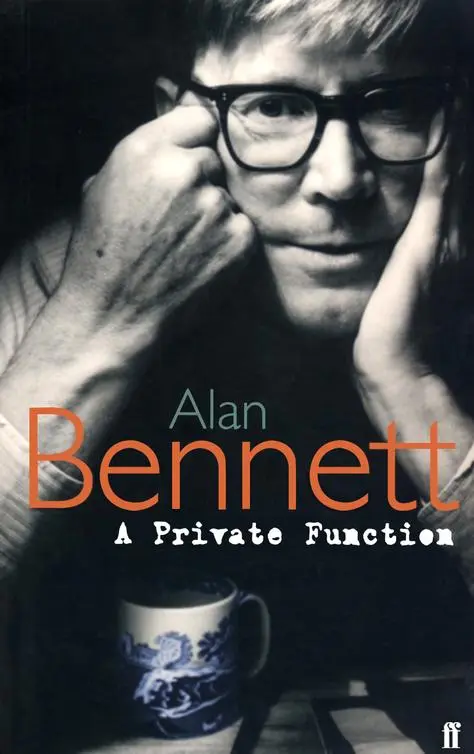
Landing Page

ALAN BENNETT
A Private Function

CONTENTS
- Title Page
- Introduction by Alan Bennett
- The Old Crowd
- A Private Function
- Prick Up Your Ears
- 102 Boulevard Haussmann
- The Madness of King George
- About the Author
- Also by the Author
- Copyright
INTRODUCTION
I have never been smitten with the romance of film or been much of a film buff. When I was a child the cinema seemed a less exciting place to visit than the theatre, partly, I suppose, because I was taken to the theatre less often and never took it for granted.
‘The pictures’, on the other hand, were routine; as a family in the forties we regularly went on a Monday and a Saturday (always to the first house) and sometimes on a Wednesday, too. Programmes changed once and sometimes twice a week and, with half a dozen cinemas within a mile or two, it was seldom hard to find a film you hadn’t seen.
This might make us seem film fans, but not then; in the years before television it was what people did. Thus in the course of my childhood I must have seen some of the classics of the screen at theit first outing – Casablanca, Citizen Kane, My Darling Clementine – with no notion that these were films of a different order from our usual twice-weekly fare. So the romance of film passed me by.
When I came to work with film directors like Lindsay Anderson, John Schlesinger and Stephen Frears I became more conscious of this gap, a gap not so much in my education (I had seen a lot of films after all) as in my sensibility. I didn’t understand the grammar of film (and still don’t); I didn’t carry a library of shots in my head and couldn’t draw on memories of classic films and how they were cut, the director’s touch and style seldom something I noticed.
I was most conscious of these shortcomings with Lindsay Anderson, whose living room was lined with videos of his favourite films, the virtues of which (sometimes quite obscure) he was always ready to expound. John Schlesinger was less of a teacher than Lindsay and was also more camp in his affiliations, and didn’t like to be thought in any way ‘arty’, so with him I felt less ignorant. Stephen Frears kept his enthusiasms to himself, sometimes seeing or contriving similarities with his favourite films, but never so explicitly as to be dubbed hommages, though his first film, Gumshoe, written by Neville Smith, was packed with such references, most of which were lost on me.
To begin with, though, the word ‘film’ did trail a certain glamour and mystery, and film acting seemed a subtler and altogether more calculated business than the acting I’d done on stage or on television. In retrospect, this seems absurd. The first filming I ever did was in Lloyd George Knew My Father (1965), a short film for television directed by Jack Gold. It starred John Bird, John Fortune and Eleanor Bron, with all of whom I was at that time regularly working on television … and on live television, too, which, if I’d thought about it, was a much more daunting process than film. At least on film you could have several goes at it (and didn’t need to know more than a few lines at a time). But it was the word ‘film’ that threw me into panic. It seemed so adult, whereas television was just playing about and being silly.
By the time I got round to writing films this sense of awe had long since gone, and when I did come to write a film it was almost without realising it. The first two television plays that I wrote, A Day Out (1972) and Sunset Across the Bay (1974), were done on location and on film, and to this day I don’t know whether to call them plays or films. They were only television films, it’s true, and in those days people working in feature films were quite condescending about television … but when I did eventually graduate to writing the occasional feature film there didn’t seem to be all that much difference anyway. The techniques were the same (though probably not the film stock), as were the personnel and even the food. It’s true feature filming was slower and more finicky, and the baggage train of vans, trucks and caravans more cumbersome, but this was presumably because feature filming was more expensive than filming for television and less routine. Certainly the fees were more generous; the actors were paid more; the writer was paid more; everyone, probably, was paid more. But it was hard not to wonder if this was one of the reasons why tempers on feature films were generally shorter: there was more at stake.
Certainly on my first feature film, A Private Function, there was more interference from the producers (to the general detriment of the film) than I’d ever experienced in a decade of making television films for the BBC. Scenes were cut without consultation, the budget was slashed, the score made jokier: all the usual weary litany of complaints film-makers have about ‘the money’. One of the producers was Denis O’Brien, the other George Harrison, and I never worked with either of them again. Experience in the world of entertainment is simply a list of people you would be happy to find yourself working with and another list of those you never want to see again; with luck the first list is longer than the second.
Included in this volume are the introductions originally published with the scripts of A Private Funotion, Prick Up Your Ears and The Madness of King George. The introduction to Prick Up Your Ears explains the circumstances in which this life of Joe Orton came to be written and the lengthy process whereby it eventually found a producer in Zenith. The earlier producers who, thinking the deal was in the bag, had then revealed their real intention to make ‘an English Cage aux Folles’ were Chrysalis Records.
This pre-production had been so protracted, though, that when at last we came to make the film I was just glad to get it out of the way so I could get on with something else. This is not the best frame of mind in which to do anything, though I can’t see how it doesn’t often afflict film-makers or at any rate scriptwriters. Besides which, as I explain in the introduction to the play, since I had mixed feelings about Orton himself it’s not surprising if I was sometimes in two minds over the film of his life.
I felt subsequently that so far as the sex scenes were concerned the film was a dry run for My Beautiful Laundrette, where Stephen Frears found a way of making the goings-on much more playful (and sexier). It was only towards the end of shooting Prick Up Your Ears that I noticed that in the bedroom scenes neither of our supposedly uninhibited characters even had their hands under the blankets.
To some extent this restraint can be put down to the times, though even in 1986 this was a little old-fashioned; and were a similar film to be made today it would need to be much more explicit (though that wouldn’t necessarily make it a better film). In the same way, I think the cottaging scene could have been earthier. It was filmed ‘artistically’ because, had it been more explicit, it would have been censored or received a harsher certificate. I have no experience of cottaging, but I’d be surprised if it was like this. Much truer in its way was a sillier lavatory scene Malcolm Mowbray improvised in A Private Function which was both funny and not implausible.
The scenes I particularly like in Prick Up Your Ears are Orton at home as a boy, Julie Walters as Orton’s mother shouting up the stairs, ‘I bet Dirk Bogarde didn’t distemper his mother’s bedspread,’ then having to bend double to avoid what she thinks is the rent-collector at the door. The scenes in Islington Public Library are also quite droll, though this, of course, is often the way with films and plays and for all I know novels: the characters who don’t carry the burden of the main plot are always the most fun to write; they’ve got time to be silly and don’t have to drive the action along.
102 Boulevard Haussmann (1990) came out of wanting to write about Proust, which in turn came out of having written about Kafka, around whom I had done two plays, one for television, The Insurance Man (1985), and a stage play, Kafka’s Dick (1986), both directed by Richard Eyre. All three scripts have to do with writers and their lives, and how life and art don’t always measure up.
Virtually contemporaries, Kafka and Proust both gave up their lives for their work, though the self-sacrifice didn’t quite make them saints – how they lived sometimes falling short of what they wrote. This is a not uncommon discrepancy, and and why writers are such tempting subjects for biography, clay feet always making for a good read. Kafka himself said that to write is to do the work of the devil, and there is a sense in which both he and Proust were supremely selfish, allowing nothing and nobody to stand in the way of the work.
Proust is tempting to write about for other reasons. The difficulty in dealing with writers in films or plays is that so often they have dull lives. Proust on the other hand had such an eccentric way of going on that it wasn’t simply a case of showing someone tearing an unsatisfactory sheet from the typewriter, screwing it up and throwing it in the wastepaper basket (Proust didn’t have a typewriter anyway).
Proust’s way of life, though well known, has not often been presented on the screen. He worked at night and slept much of the day; he had elaborate rituals involving food and clothes, and was rich enough to indulge them or have them indulged by his lifelong servant, Céleste Albaret. We took trouble about the exact representation of this life, making sure that the layout of the set at Elstree corresponded to the actual topography of Proust’s airless and cork-lined apartment in the Boulevard Haussmann; not, I’m sure, that anybody noticed or would have cared if they had.
In other respects, too, it’s a film that is faithful to the facts of Proust’s life. The quartet were summoned to his apartment to play for him in the middle of the night; he did (over) pay them in notes from a box of money from the sideboard before sending them off home in cabs having earlier fed them on food from the Ritz, which he was accustomed to use as a takeaway. There are, of course, much darker and more sensational episodes in Proust’s life, but for all its sad undertones this is one of the most appealing.
It was not an easy film to make, fiercely hot throughout most of the shooting, and no fun at all for Alan Bates, who was decked out in Proust’s suffocating assortment of vests and undergarments. At the time I thought the film would attract little notice, nor did it, and it’s never been repeated or the script printed until now. Still, we must have had a good time, and there’s a photograph of Alan Bates and myself (reproduced in Writing Home) sitting on one of Proust’s sofas, both of us helpless with laughter.
About The Old Crowd and The Madness of King George I have nothing much to add to what I’ve already written. The Old Crowd, the original TV script of which is printed in an earlier volume, was one of a succession of films that Lindsay Anderson developed but never managed to make. The money in this case had been allocated by the Swedish Film Institute, and I adapted my TV script, which Lindsay then rewrote. It was wasted labour for both of us as we then found that someone in Sweden had pocketed the funds, a circumstance which Lindsay found entirely unsurprising.
No such setbacks affected the making of The Madness of King George, which was an entirely happy experience. Nigel Hawthorne, who had played the part so notably on the stage, was anxious lest, like other stage successes of his, the part might be taken over in the film by an actor with more box-office clout. This had happened with the film of Shadowlands, in the play of which Nigel had had a great success as C. S. Lewis, but which, when it came to the film, was played by Anthony Hopkins.
So identified was Nigel with the part, no other actor was even considered, nor indeed any other director, though it would not have been hard to find one with a better track record than Nicholas Hytner, who, never having made a film, had no track record at all. The upshot was that the film was made with the same team as had done the play, a circumstance which gained us some moral credit in the profession. I’m not sure that this was entirely deserved, as my cupidity had never actually been put to the test. If someone in Hollywood had offered me five million dollars for the script on the understanding that George III was played by Sylvester Stallone, who knows what my reaction might have been?
Unsurprisingly, though, nobody did.
The Old Crowd
CAST
in order of appearance
PIANO TUNER
GEORGE
BETTY
HAROLD
GLYN
RUFUS
PAULINE
STELLA
DICKIE
BRIAN
KEVIN
SVEND
OSCAR
MOTHER
PETER
SUE
MR GREGORY
MRS BROOKSTONE
TOTTY
CAPTAIN
SERGEANT
ASSISTANT DIRECTOR, WARDROBE MISTRESS, YOUNG FAMILY, SCHOOLMASTER, PUPIL, NUNS, PATIENTS, CONDUCTOR, SOLOISTS, CABBY, SOLDIERS, MEDICAL AUXILIARIES, NURSE, OFFICIALS, ORDERLY, FUMIGATION SQUAD, DRESSER, ASSISTANT, DIRECTOR
EXT. ENGLISH ROADS. DAY.
A large furniture-removal van drives speedily across an empty landscape.
EXT. TOWN HOUSE (STILL PHOTO). NIGHT.
A still shot of the outside of a large, early twentieth-century London house. Camera tracks slowly in. Sound of piano tuning heard over.
INT. HOUSE. HALL AND MUSIC ROOM. NIGHT.
A spacious, completely empty hall. Walls are bare and white. Naked electric light bulbs – unshaded. No carpets on the floor. Windows are covered with newspaper. Through a door we see a large grand piano. At it is seated a Piano Tuner, a big man wearing dark glasses. Beside him is sitting a large dog. The camera tracks round until it is looking up an important staircase.
INT. UPSTAIRS CORRIDOR. NIGHT.
Camera tracks very slowly down the long corridor. The sound of voices from a room far down on the right.
BETTY Careful!
GEORGE That won’t work.
BETTY My idea was better.
George and Betty emerge slowly from the room, carrying a large mirror between them. She is in her undies: he is half-dressed in evening clothes. They edge across the corridor, disappearing into the bedroom on the left.
GEORGE I refuse to be defeated.
BETTY We shouldn’t be having to do this at all.
GEORGE (as they disappear into the bedroom) Over in the corner.
The corridor empty again. The piano-tuning noise continues downstairs. Sound of heavy bump.
The camera continues to track slowly down the corridor and eventually peers round the bedroom door. We see George and Betty, a middle-aged couple, getting dressed for a dinner party. The room is bare, with two camp beds with sleeping bags on them. Open suitcases on the floor; a travelling clock. A bathroom gives off the bedroom.
INT. BEDROOM AND BATHROOM. NIGHT.
George sits on his bed, cleaning his shoes. Betty gets her dress and carries it into the bathroom. She does her make-up in a cracked mirror propped up above the basin.
GEORGE You think we’re making the right decision?
BETTY What?
GEORGE You think we’re making the right decision?
BETTY Don’t let’s start all that again.
GEORGE I only wish Totty could be here.
BETTY Mmmm …
GEORGE It sounded quite serious.
BETTY It can’t be all that serious. She was talking about Scotland.
GEORGE It’s organic.
BETTY Is that serious?
GEORGE They’re called antibodies. Apparently she’s got too many. Or too few.
BETTY (running the tap) Oh dear!
GEORGE Poor Totty.
BETTY (switching off the tap) What?
GEORGE I said poor Totty.
BETTY (switching the tap on again. More slowly) Oh, yes.
GEORGE Is Oscar bringing that boy?
BETTY He does have a name.
GEORGE What is his name?
BETTY Svend. With a ‘d’.
GEORGE He never speaks.
BETTY He’s Swedish. I like him.
GEORGE He’s an improvement on the German.
BETTY Did you call the children?
GEORGE Yes.
BETTY Are they coming?
GEORGE If it’s humanly possible. I warned them to set off in good time just in case.
BETTY They’re both very sensible.
GEORGE No regrets?
BETTY No regrets.
GEORGE And you’re sure we’re doing the right thing?
BETTY Yes, we are.
GEORGE Just think, at this moment all over London our friends are making their way towards us.
They advance towards one another to embrace when the telephone rings. They look at the telephone. George picks it up. It is dead.
INT. CORRIDOR. NIGHT.
George and Betty emerge into the corridor as the telephone continues to ring. They listen outside doors. Betty opens a door, switches on a light, and signals to George. He comes up, and walks ahead of her into the room.
INT. EMPTY ROOM. NIGHT.
George comes up to telephone, on the floor in the middle of the empty room, still ringing. As he comes to it, it stops. George, picks it up, puts it to his ear. Nothing. He passes it to Betty. As she is handing it back to him, the front doorbell chimes.
INT. STAIRS AND HALL. NIGHT.
George comes down the stairs; he is still not completely dressed. The doorbell chimes again – two notes. The Piano Tuner echoes the same two notes on the piano. George goes to look through the open door at him.
INT. MUSIC ROOM. NIGHT.
The Piano Tuner senses George’s presence in the doorway and raises his head, but doesn’t strike any more notes. George softly closes the door.
INT. HALL. NIGHT.
George unbolts the front door. Two men are waiting outside. One is tall, in his fifties, the other slighter and very unkempt, in his twenties. Harold, the elder, carries a small attaché case. Glyn, the younger, carries two large suitcases.
HAROLD Mr Nelson?
GEORGE Who are you?
HAROLD The slaves.
GEORGE The slaves! Of course. Enter. Enter.
George makes a point of bolting the door, looking out first. The waiters look round.
GEORGE (joining them) You got here all right? No problems?
HAROLD Harold.
GEORGE Harold.
HAROLD Glyn.
GEORGE Glyn.
George has put out his hand but somehow it is not seen and he puts it away again. The sound of piano tuning starts again.
GEORGE I’m afraid we have only the barest essentials at the moment, pending the arrival of our furniture … one’s bits and pieces. Still I think you’ll find we have gas, water and electricity. All mains services.
George leads the way towards a door connecting with the kitchen stairs. Harold and Glyn follow.
INT. KITCHEN STAIRS AND KITCHEN. NIGHT.
A large, old-fashioned kitchen with a door that gives on to a basement area outside. Large new oil stove and sink fittings. There is a large crate in the middle of the empty floor. George appears down the staircase.
GEORGE I think you’ll be pleasantly surprised by the kitchen. Plenty of elbow room here. And – (He indicates the crate.) – your people brought this round earlier. I imagine it’s all in there.
Harold puts his attaché case on the crate and opens it. Glyn snoops around, opens and closes the back door.
GEORGE Do you do this full-time?
HAROLD We’re actors. We act.
GEORGE Acting. That is exciting. Are you ‘resting’?
HAROLD Excuse me?
GEORGE That’s what it’s called, isn’t it, when you’re out of work? Resting?
HAROLD I call it out of work.
GEORGE What sort of parts do you play?
HAROLD Glyn frequently plays policeman’s parts, don’t you, Glyn?
Glyn smiles.
GEORGE He’s a bit slight for a policeman.
HAROLD That’s the sort of policeman he plays. The sensitive one who cracks under the strain of the constant brutality.
Harold has opened his attaché case. It contains a roll of cloth which he opens to reveal various tools in pouches. George picks up one out of curiosity but Harold takes it from him and puts it on one side.
GEORGE And what do you play?
GLYN Where is the toilet?
HAROLD I also play policemen, at a more senior level.
GEORGE Well, it’s all acting, isn’t it?
Harold hands him a large card.
GEORGE Ah. The bill of fare.
GLYN Where is the toilet?
HAROLD Where is the toilet?
GEORGE This looks delicious. Are you desperate?
GLYN I am.
GEORGE Well, we have a problem. Typical story. Workmen here going on six months … floors up, ceilings down. Nightmare. Job completed. Workmen depart. We come to use the toilet and it doesn’t work. Four toilets and three don’t work.
HAROLD He had every intention of going at the station, only the vandals had got there first.
GEORGE Come upstairs.
INT. HALL AND STAIRS. NIGHT.
George and Glyn emerge from the kitchen staircase, cross the hall and start to climb the stairs. We hear the piano tuning again.
INT. KITCHEN. NIGHT.
Harold has hung his dress suit from a hook in the ceiling. He finishes brushing it. He takes a tape from his case and starts to measure the walls.
INT. UPSTAIRS CORRIDOR. NIGHT.
As Glyn follows George down the corridor, he checks, tries a door, finds it open and goes inside, turning on the light. George goes back. He follows Glyn into the room.
INT. EMPTY UPSTAIRS ROOM. NIGHT.
As George goes into the room, Glyn disappears through another door, back into the corridor, so he is now ahead of George. George withdraws into the corridor again.
INT. UPSTAIRS CORRIDOR. NIGHT.
Glyn is now waiting innocently for George, who walks on down the corridor past him, again leading the way.
GEORGE This way.
INT. BEDROOM. NIGHT.
George enters, followed by Glyn. Betty, now dressed, enters from the bathroom.
GEORGE Glyn here is just going to use the bathroom.
Glyn edges his way past Betty, unnecessarily close. He grins unpleasantly and goes into the bathroom. Betty glares. George smiles.
INT. STAIRS AND HALL. NIGHT.
George is following Betty down the stairs; he is now fully dressed.
BETTY All I’m saying is, one doesn’t ask to use the loo before one has barely set foot in the house.
The Story Continues on BooksBarbecue!
Enjoyed this preview? ❤️ Do not stop here!
Read the complete book free online → 🔗
Continue reading now on BooksBarbecue and discover every page!
Love reading? Bookmark BooksBarbecue.com for more amazing books!
Happy Reading!