A Perfect Explanation
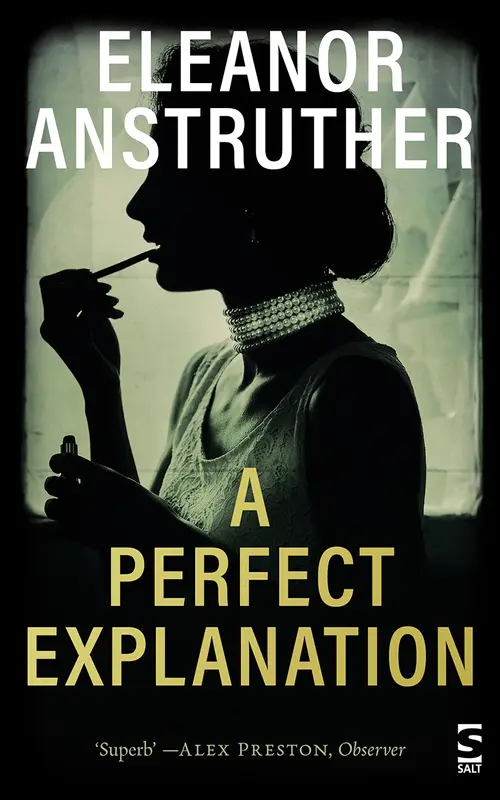
A PERFECT EXPLANATION
by
Eleanor Anstruther
SYNOPSIS
Observer: Fiction to look out for in 2019
The i Paper’s 30 of the best new debut novels to read in 2019
Exploring themes of ownership and abandonment, Eleanor Anstruther’s debut is a fictionalised account of the true story of Enid Campbell (1892–1964), granddaughter of the 8th Duke of Argyll.
Interweaving one significant day in 1964 with a decade during the interwar period, A Perfect Explanation gets to the heart of what it is to be bound by gender, heritage and tradition, to fight, to lose, to fight again. In a world of privilege, truth remains the same; there are no heroes and villains, only people misunderstood. Here, in the pages of this extraordinary book where the unspoken is conveyed with vivid simplicity, lies a story that will leave you reeling.
PRAISE FOR THIS BOOK
‘A riveting story about class and inheritance that explores how chance events can kick off a chain of consequences and seemingly minor decisions create catastrophes. It is exquisitely written – it reminded me of reading Elizabeth Taylor or Virginia Woolf. It is crammed with cruelties both big and small and yet Anstruther brings these finely crafted characters to life with both an unflinching eye for their faults and a compassion for those trying to survive in a society where love is rationed. I was utterly gripped – even more so because the story is based on true events. Take note folks, Eleanor Anstruther is the real deal.’ —Tor Udall
‘Gripping and beautifully written, this is a story about motherhood, privilege and women who simply won’t, or can’t, fit in. A brilliant read. I loved it.’ —Eve Chase
‘I read A Perfect Explanation almost between my fingers – such a haunting story, beautifully told, about an exceptional situation that somehow goes to the heart of the many truths, deceptions and lies recognisable in many families. One feels so sorry for each character in turn – Enid, Finetta, Ian, all victims of time, failings and circumstance. The clashes between motherhood, religion, class, gender and personalities are all the more affecting for being portrayed with clarity and fairness. Eleanor Anstruther has written a fascinating debut and an imaginative reconstruction of her own family history.’ —Amanda Craig
‘Although it’s not a happy read, the emotional intensity drives the reader on … and on. The journey of the beautiful socialite in the spotlight, to the sociopath in the shadows is compelling and will, I am sure, hit a nerve for many of the novel’s readers. An intense and thought-provoking read.’ —Essie Fox
‘What a task to take on – diving into the inner world of desperately flawed and broken people and still finding a way to elicit our sympathy. Such a brave, unflinching portrait of a family.’ —Matthew Tynan
‘Anstruther exhumes the skeleton in her family closet with devastating skill. A captivating, chilling, deeply insightful portrait of a family torn apart by responsibilities both taken on and pushed aside. ’ —Sam Bain
REVIEWS OF THIS BOOK
‘Eleanor Anstruther’s superb debut, A Perfect Explanation (Salt, March), the fictionalised story of the granddaughter of the eighth Duke of Argyll, who sold her son to her sister for £500.’ —Alex Preston, The Observer
A Perfect Explanation
Eleanor Anstruther was born in London, educated at Westminster and read History of Art at Manchester University. She lives in Surrey with her twin boys.

Published by Salt Publishing Ltd
12 Norwich Road, Cromer, Norfolk NR27 0AX
Copyright © Eleanor Anstruther, 2019
The right of Eleanor Anstruther to be identified as the author of this work has been asserted by hwe in accordance with Section 77 of the Copyright, Designs and Patents Act 1988.
This book is in copyright. Subject to statutory exception and to provisions of relevant collective licensing agreements, no reproduction of any part may take place without the written permission of Salt Publishing.
Salt Publishing 2019
Created by Salt Publishing Ltd
This book is sold subject to the conditions that it shall not, by way of trade or otherwise, be lent, re-sold, hired out, or otherwise circulated without the publisher’s prior consent in any form of binding or cover other than that in which it is published and without a similar condition including this condition being imposed on the subsequent purchaser.
ISBN 978-1-78463-165-9 electronic
To Pardy
As Bad as a Mile
Watching the shied core
Striking the basket, skidding across the floor,
Shows less and less of luck, and more and more
Of failure spreading back up the arm
Earlier and earlier, the unraised hand calm,
The apple unbitten in the palm.
philip larkin
Finetta, 1964
1
Finetta, 1964
What irritated Finetta about her mother was not the lack of love but the obvious hatred. Lack of love was easy to explain – her mother had loved others more, her love was finite, there was only so much to go round. But her hatred was endless. Finetta had tried in myriad ways to understand it, but at forty-four, she was tired. It was inexplicable. She had to live with it.
For her own daughter she felt little either way. She neither loved nor hated her. She felt ambivalent towards her and the ways about her: her presence, how she did her hair or poured the tea. Her daughter was a stranger who moved with a stranger’s mood; a thing that passed and left little trace, unlike her son, for whom she felt a love so crushing she could only watch him, constantly, whether he was there or not. She wondered, sometimes, if it mattered; this black and white way of her heart – but what could she do? There was either feeling, or there wasn’t, and neither force – ambivalence nor adoration – had dissuaded her from duty. She’d fed and bathed them both, divorced their father and sent them away to school as soon as possible. They had grown up. Now she found herself back in the role for which she was made and in which she felt the least and most comfortable – that of looking after her mother. Her mother’s nursing home was in Hampstead. It looked pretty from the outside, a large red brick house on a quiet street, but the inside had been stripped of beauty – it had unfortunate lighting and a lift that didn’t work, Formica tables, single beds and nylon sheets. It was her mother’s just deserts.
She looked at the letter again while the kettle boiled. Coming Tuesday. No need to tell her, better not. I won’t stay long. Shall we lunch beforehand? Say 1pm, usual place? Ian
Better not to tell her for whom? Him? Her? Their mother? Obviously she’d had to tell the nurses – they liked to know the name of every visitor – but she’d made it clear. She’d made it absolutely clear that they weren’t to say a word until she got there. She’d be the one to say, Ian’s here. He’s come to see you. Not the nurses with their incontinent nonsense, spilling it out as though it were something thrilling. No. Finetta would be the one to tell her – perhaps she’d have to make him wait outside the door, but it would be her who’d do the spilling, with care and consideration and just enough distance to duck. Her mother might think her a bloody nuisance, but she wasn’t cruel or stupid. She knew what it all meant. She put the letter back in its envelope, propped it again on the shelf beside her notebook and got her cup and saucer from the cupboard.
Finetta was beautiful and tall. She had hooded blue eyes like a sculptor’s Nemesis set in an angular face framed by thick dark hair that waved gently without curlers. She’d cut it to shoulder length and wore it clipped back like a schoolgirl. She was thin, as her mother was, with elegant hands that drew attention from her face when men were desperate to look somewhere else. She wore no rings – her failed marriage was discarded in the bottom drawer of her bureau.
The kettle boiled, the pot already warmed on the Rayburn. While the tea steeped she sat at her kitchen table, a quilt on her lap, and opened the sewing box. It was to have been a Christmas present for her mother but she’d almost finished it. One more patch to go. She could finish it this morning and give it to her this afternoon. It was probably better not to wait for such dates as Christmas or birthdays anymore – in the face of her mother’s deterioration they had become arbitrary. Who knew if she’d live till then? It was better to finish the patch now and give it to her before death crept any closer.
It was pretty enough, pieces cut from old dresses and curtains, backed on to undyed linen. Her mother would hate it but the nurses would think her ungrateful and keep putting it back on her bed. It gave Finetta joy to think of the confusion, the kind prison her mother was in. She rearranged the quilt to stop it slipping from her knee.
Starting something was easy, she thought as she adjusted a pin. It was the starting that was the joy when no mistakes had been made, when the world was free and open, when nothing was said that needed to be unsaid and there were no bad stitches. If life were nothing but beginnings with something else taking over the difficult middle and horrid end, how much simpler it would be. How much happier. People were not designed to change – God had not thought it through. They broke down instead, but what did God know? He who had made such a hash of it all. God was a trick made up by people too frightened to think of anything else. She spread the quilt over the table. It would do. Most of the mistakes were hidden under calico.
She poured her tea and arranged herself again at the kitchen table, the quilt on her knee. Her needle travelled back and forth through the patch of red silk dotted with white flowers and she kept her eyes upon it. She was used to the sharp sting of a misdirected point and though she’d done it – made patchworks, darned socks, mended skirts – a thousand times before, she still got pricked occasionally and it still stung.
She stopped for a moment, drank some tea and sniffed. Winter. What a bore. Freezing nights and her mother still not complaining. If only she would act normally, like all the others who crowded into that dreadful place, getting meat jammed in their teeth and holding hot water bottles to their stomachs, wiping their streaming eyes with the backs of their painful hands and chivvying each other along. But her mother refused to be drawn. She was silent, focused, upright except to turn slow watery eyes upon her daughter, fail to smile and look away. She never asked her how she was, never said thank you when Finetta drove halfway into town to fetch her new stockings, never said thank you at all.
With her ankles crossed, a cashmere thrown over her shoulders, an electric fire pulled to the middle of the kitchen floor emitting a three-bar heat, Finetta looked like a flower grown used to growing in the dark. Precision, that’s what she cared about, a commanding order that gave her life outline. Tea before toast, a quilt before death, an annual lunch with her brother. She turned it over, tied the thread and snapped it with her teeth. The last patch was from a blanket the moths had got to. She hadn’t liked it. It had reminded her of poverty.
The Rayburn poured slow heat over clean tiles, empty surfaces, polished sink. The cupboards, worktops and floor were all varying shades of tan. Tan, she’d discovered, was an easy colour to make look clean. She took a half-loaf of bread from the bread tin, a board from behind the sink, a knife from the drawer, and cut a slice. Tea, toast, precision, quilts, her mother, and occasionally she made fudge in the afternoon when she’d nothing better to do – she had tins of the stuff, she couldn’t keep up – but these things kept her occupied. As a child she’d had her bird book.
It had been easier then – her thoughts had not developed the ragged edges they had now, the subtle insistence that there was more to realise if only she’d follow them up. When she was a child they had been single, isolated cut-outs which had been easily replaced with a picture of a robin. Now she had to look away sharply to avoid seeing what her thoughts dragged with them. But she was strong. She would not be drawn. It did no one any good.
She stood at the worktop and buttered her toast. Surely she was too old to feel angry. She wished the sensations would go away. There was no need for them, and it was rude of them, in her quiet kitchen, to think they could intrude when she was supposed to be getting dressed and getting ready for a normal day that had just one little bump in it. They had begun to intrude more and more, edging in until it seemed normal to see them inside the door, sitting on the kitchen floor, crouched at the foot of her chair. Soon they’d find their way into her bedroom. Then she’d have to take a sleeping draught to keep them away.
She’d spent her life believing things could be compartmentalised, kept apart by scissors and sticky tape, labelled and stuck down with no risk of one image sneaking over to another. She’d had her mother page, where she’d been Neat, Solemn, Quiet to the point of Piousness. On her aunt’s page were Good Manners, Amusing Chatter and Gossip. With her father she was Pretty and Happy; with her brother, Un-minding and Stoic – it had all worked surprisingly well until she’d grown up and left home. But as an adult, the overlay of romances, children and divorce had smudged the cut outs and she’d returned to the pages to find they had bled one into another. Who could she be to her brother now? Why did Neat no longer work with her mother? It was as if survival was a debt she must repay by ghastly examination. She didn’t want to peel the images apart. She didn’t want to look. She should tell her mother to stuff it, but was over-ruled by a small girl in pig tails with a bird book trying to pour tea without spillage. What about loyalty? Yet she returned, week after week to attend to that disappearing life as if it had offered her warmth. Her brother said she was a fool, yet the older she got, the younger she became. She’d got along perfectly well for forty-four years refusing to be affected by anything. Why start now? But, like everything else in the childhood that crept upon her, it felt beyond her control.
She rubbed her chest with the heel of her hand. She wanted to put the contents in the sink with her cup, wash them up, pour them away. Of course she couldn’t. She had to clench her jaw, go upstairs and get dressed. She kept a firm grip on the knife as she ran the blade under hot water.
In the bathroom, she inspected her face. It will do, she thought, touching her lips with the tips of her fingers. She always thought that as she moved away from her reflection. It will do. She knew she’d been beautiful, as if it were a fact stored in a book at the London Library. Everyone said it and men, well, they’d ogled her, but what she saw was pointed and sharp. She saw her mother’s eyes and her mother’s mouth and wished she didn’t.
As she ran her bath she thought she heard the telephone ringing. She turned off the taps and opened the bathroom door, but the house was as still and as quiet as ever. Nothing. She shut the door and turned on the taps again. She undressed, laying her cashmere over the back of the bathroom chair and her nightgown folded neatly on the seat. Gratefully, she stepped into the deep, warm water. Thank goodness the boiler had been mended. The water was piping. But just as she dropped her head back and let the water slop over her, the phone started ringing again.
Goddamn it, she thought, sloshing her legs and getting out. She wrapped a towel around her and padded downstairs, shoulders wet, the tips of her hair dripping.
Enid, 1964
2
Enid, 1964
From her chair by the window, Enid stared at the trees which bowed and swayed and threatened to dislodge the pigeons that clung there. Her reflection was ghost-like in the glass. The light picked out her crinkled skin, the sag of her cheeks, how thin her mouth had become. Her hands, folded in her lap, conveyed the essence of her bones; gnarled with a tremor that mislaid things.
She was trying not to think of her sister. She was trying very hard indeed. She’d mostly erased her, she’d almost got rid of her completely, but this morning, up she’d come, resurfacing like so much flotsam, as present as if she were in the room – the living, breathing Joan who perhaps still lived and breathed somewhere. Enid could almost smell the trail of Turkish tobacco, the slick of gin and hint of eau de lavender, could almost see the defiant bones that broadened that face, the globe eyes, the heavy lids open on blue islands with black at their heart. One of these days it wouldn’t just be memories, it would be her in spirit, come to say sorry.
But today it was memories, and although she closed her eyes and opened them again, though she stared at the trees and counted the pigeons and made a bet with herself over which would fly off first, her sister reared before it all, blotting out everything like the ghost that she couldn’t get rid of.
Her fingers played over a ring on her left hand; an emerald set amongst diamonds on a band of deep gold. Ageless and prominent as if washed up on driftwood, the jewels glinted above skin that had lost its fat and become the colour of mud-spattered sand. Once upon a time, even after Joan had got the knives out, Enid was young and beautiful; always more beautiful and younger than Joan, and perhaps that was the shallowest of causes. Just that. She even had a portrait by Augustus John to prove it – her head half-turned, her hand in mid gesture as if she were saying something. She had been, though she couldn’t remember what. It had moved with her, from one corridor wall to another and finally to here, a bedside cupboard in Hawthorne Christian Science House.
She pushed her thumbs against the top bones of her eye sockets, making her forehead ache. She wished she could stop thinking of her. Like the television downstairs that fired pictures of American soldiers into the shabby lounge of the nursing home, Joan transformed a tired plain into a place of war. The anger that slept and the grief that haunted woke up and shouted, the hurt showed itself undimmed and Enid’s thoughts became furies, a battlefield overrun with blood and trenches. On days like these it was impossible to traverse from one side of her mind to the other without falling in a hole, tripping on a jagged bone or snagging her skirts on barbed wire; her very own Vietnam or Gallipoli, alive with a carnage she couldn’t stop.
There was a knock on her door.
“Enid?” It was Carol, one of the nurses. Fat Carol with the piggy eyes, come to brush her hair and clean her up, ready for her weekly visit from Finetta.
The Story Continues on BooksBarbecue!
Enjoyed this preview? ❤️ Do not stop here!
Read the complete book free online → 🔗
Continue reading now on BooksBarbecue and discover every page!
Love reading? Bookmark BooksBarbecue.com for more amazing books!
Happy Reading!