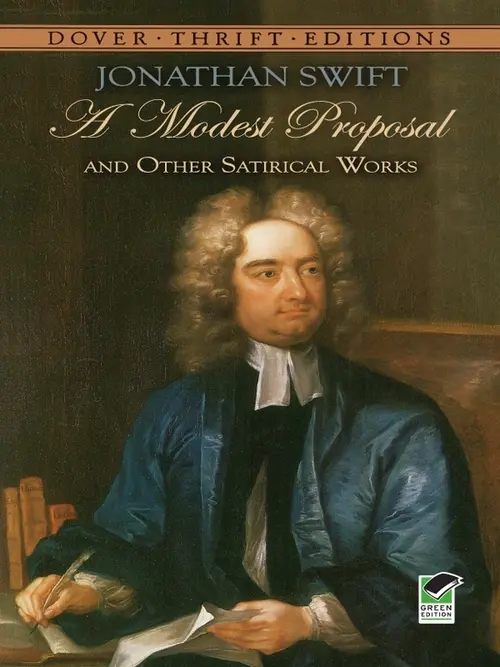
A Modest Proposal and Other Satirical Works
Title Page

At Dover Publications we’re committed to
producing books in an earth-friendly manner and
to helping our customers make greener choices.
Manufacturing books in the United States ensures compliance with strict environmental laws and eliminates the need for international freight shipping, a major contributor to global air pollution. And printing on recycled paper helps minimize our consumption of trees, water and fossil fuels.
The text of this book was printed on paper made with 30% post-consumer waste and the cover was printed on paper made with 10% post-consumer waste. At Dover, we use Environmental Defense’s Paper Calculator to measure the benefits of these choices, including: the number of trees saved, gallons of water conserved, as well as air emissions and solid waste eliminated.
Please visit the product page for A modest Proposal and Other Satirical Works at
www.doverpublications.com to see a detailed account of the environmental
savings we’ve achieved over the life of this book.
DOVER THRIFT EDITIONS
GENERAL EDITOR: STANLEY APPELBAUM
EDITOR OF THIS VOLUME: CANDACE WARD
Bibliographical Note
This Dover edition, first published in 1996, is a new selection of five works by Jonathan Swift, reprinted from The Works of Jonathan Swift in two volumes, edited by Thomas Roscoe (London: Henry G. Bohn, 1851). A new introductory Note and explanatory footnotes have been specially prepared for this edition.
Copyright Page
Copyright
Library of Congress Cataloging-in-Publication Data
Swift, Jonathan, 1667-1745.
A modest proposal and other satirical works / Jonathan Swift.
p. cm.—(Dover thrift editions)
Contents: The battle of the books (1697)—A meditation upon a broomstick (1701)—
A discourse concerning the mechanical operation of the spirit (1704)—An argument
against abolishing Christianity in England (1708)—A modest proposal (1729).
9780486110752
1. Ireland—Politics and government—18th century—Humor. 2. Religious satire,
English. 3. Political satire, English. 1. Title. II. Series
PR3722 1996
828’.509—dc20 95-51096
CIP
Note
JONATHAN SWIFT (1667-1745) was born in Ireland. His father died before he was born, and he, his sister and mother relied upon the generosity of relatives for their maintenance. Swift was educated at the best schools in Ireland, first Kilkenny School, and later Trinity College in Dublin. Like many of his Anglo-Irish contemporaries, he took refuge in England after the Revolution of 1688.
Around this time Swift joined the household of Sir William Temple, acting in a secretarial capacity. Swift’s association with Temple (whom he defended in “The Battle of the Books”) continued until Temple’s sudden death in 1699. While employed by Temple, Swift began writing verse. His poetry, however, never achieved the acclaim of his prose. Swift’s earliest satirical work, A Tale of a Tub, composed sometime between 1696 and 1699, was published anonymously in 1704, along with “The Battle of the Books” and “A Discourse Concerning the Mechanical Operation of the Spirit.” Despite its anonymous publication, these three works were recognized as Swift’s and he soon earned the reputation of a wit and keen political satirist.
In England, Swift’s reputation grew with his political alignment with the Tory government then in power. Though his views were primarily Whiggish, the Tories promised greater support of the Anglican Church in Ireland. Swift had been ordained an Anglican priest in 1795, and though his personal beliefs did not always conform to those of the Tory party, he became their chief political writer. In 1714, the Tory party lost power, and Swift returned to Ireland to assume the deanery of St. Patrick’s Cathedral in Dublin. Swift’s writings of the 1720s and 1730s are characterized by his fervent support of the Irish cause. The most famous of these works is “A Modest Proposal,” which is still a model of satiric political parody. Swift died in 1745 and was buried in St. Patrick’s. His epitaph, which he composed himself, is a challenge to imitate his efforts to “champion liberty.”
Editorial footnotes are indicated by Arabic numerals while unnumbered notes are Swift’s.
A FULL AND TRUE ACCOUNT OF THE BATTLE FOUGHT LAST FRIDAY BETWEEN THE ANCIENT AND THE MODERN BOOKS IN SAINT JAMES’S LIBRARY.1
THE BOOKSELLER TO THE READER.
THE FOLLOWING DISCOURSE, as it is unquestionably of the same author, so it seems to have been written about the same time, with the former;2 I mean the year 1697, when the famous dispute was on foot about ancient and modern learning. The controversy took its rise from an essay of sir William Temple’s upon that subject; which was answered by W. Wotton, B. D., with an appendix by Dr. Bentley, endeavouring to destroy the credit of Æsop and Phalaris for authors, whom sir William Temple had, in the essay before mentioned, highly commended. In that appendix the doctor falls hard upon a new edition of Phalaris, put out by the honourable Charles Boyle,3 now earl of Orrery, to which Mr. Boyle replied at large with great learning and wit; and the doctor voluminously rejoined. In this dispute the town highly resented to see a person of sir William Temple’s character and merits roughly used by the two rever- end gentlemen aforesaid, and without any manner of provocation. At length, there appearing no end of the quarrel, our author tells us that the BOOKS in St. James’s Library, looking upon themselves as parties principally concerned, took up the controversy, and came to a decisive battle; but the manuscript, by the injury of fortune or weather, being in several places imperfect, we cannot learn to which side the victory fell.
I must warn the reader to beware of applying to persons what is here meant only of books, in the most literal sense. So, when Virgil is mentioned, we are not to understand the person of a famous poet called by that name; but only certain sheets of paper bound up in leather, containing in print the works of the said poet: and so of the rest.
THE PREFACE OF THE AUTHOR.
Satire is a sort of glass wherein beholders do generally discover everybody’s face but their own; which is the chief reason for that kind reception it meets with in the world, and that so very few are offended with it. But, if it should happen otherwise, the danger is not great; and I have learned from long experience never to apprehend mischief from those understandings I have been able to provoke: for anger and fury, though they add strength to the sinews of the body, yet are found to relax those of the mind, and to render all its efforts feeble and impotent.
There is a brain that will endure but one scumming; let the owner gather it with discretion, and manage his little stock with husbandry; but, of all things, let him beware of bringing it under the lash of his betters, because that will make it all bubble up into impertinence, and he will find no new supply. Wit without knowledge being a sort of cream, which gathers in a night to the top, and by a skilful hand may be soon whipped into froth; but once scummed away, what appears underneath will be fit for nothing but to be thrown to the hogs.
A FULL AND TRUE ACCOUNT, ETC.
Whoever examines, with due circumspection, into the annual records of time, will find it remarked that war is the child of pride, and pride the daughter of riches:—the former of which assertions may be soon granted, but one cannot so easily subscribe to the latter; for pride is nearly related to beggary and want, either by father or mother, and sometimes by both: and, to speak naturally, it very seldom happens among men to fall out when all have enough; invasions usually travelling from north to south, that is to say, from poverty to plenty. The most ancient and natural grounds of quarrels are lust and avarice; which, though we may allow to be brethren, or collateral branches of pride, are certainly the issues of want. For, to speak in the phrase of writers upon politics, we may observe in the republic of dogs, which in its original seems to be an institution of the many, that the whole state is ever in the profoundest peace after a full meal; and that civil broils arise among them when it happens for one great bone to be seized on by some leading dog, who either divides it among the few, and then it falls to an oligarchy, or keeps it to himself, and then it runs up to a tyranny. The same reasoning also holds place among them in those dissensions we behold upon a turgescency in any of their females. For the right of possession lying in common, (it being impossible to establish a property in so delicate a case,) jealousies and suspicions do so abound, that the whole commonwealth of that street is reduced to a manifest state of war, of every citizen against every citizen, till some one of more courage, conduct, or fortune than the rest seizes and enjoys the prize: upon which naturally arises plenty of heart-burning, and envy, and snarling against the happy dog. Again if we look upon any of these republics engaged in a foreign war, either of invasion or defence, we shall find the same reasoning will serve as to the grounds and occasions of each; and that poverty or want, in some degree or other, (whether real or in opinion, which makes no alteration in the case,) has a great share, as well as pride, on the part of the aggressor.
Now, whoever will please to take this scheme, and either reduce or adapt it to an intellectual state or commonwealth of learning, will soon discover the first ground of disagreement between the two great parties at this time in arms, and may form just conclusions upon the merits of either cause. But the issue or events of this war are not so easy to conjecture at; for the present quarrel is so inflamed by the warm heads of either faction, and the pretensions somewhere or other so exorbitant, as not to admit the least overtures of accommodation. This quarrel first began, as I have heard it affirmed by an old dweller in the neighbourhood, about a small spot of ground, lying and being upon one of the two tops of the hill Parnassus; the highest and largest of which had, it seems, been time out of mind in quiet possession of certain tenants, called the Ancients; and the other was held by the Moderns. But these, disliking their present station, sent certain ambassadors to the ancients, complaining of a great nuisance; how the height of that part of Parnassus quite spoiled the prospect of theirs, especially toward the east; and therefore, to avoid a war, offered them the choice of this alternative, either that the ancients would please to remove themselves and their effects down to the lower summit, which the moderns would graciously surrender to them, and advance into their place; or else the said ancients will give leave to the moderns to come with shovels and mattocks, and level the said hill as low as they shall think it convenient. To which the ancients made answer, how little they expected such a message as this from a colony whom they had admitted, out of their own free grace, to so near a neighbourhood. That, as to their own seat, they were aborigines of it, and therefore to talk with them of a removal or surrender was a language they did not understand. That if the height of the hill on their side shortened the prospect of the moderns, it was a disadvantage they could not help; but desired them to consider whether that injury (if it be any) were not largely recompensed by the shade and shelter it afforded them. That as to the levelling or digging down, it was either folly or ignorance to propose it if they did or did not know how that side of the hill was an entire rock, which would break their tools and hearts, without any damage to itself. That they would therefore advise the moderns rather to raise their own side of the hill than dream of pulling down that of the ancients; to the former of which they would not only give licence, but also largely contribute. All this was rejected by the moderns with much indignation, who still insisted upon one of the two expedients; and so this difference broke out into a long and obstinate war, maintained on the one part by resolution, and by the courage of certain leaders and allies; but, on the other, by the greatness of their number, upon all defeats affording continual recruits. In this quarrel whole rivulets of ink have been exhausted, and the virulence of both parties enormously augmented. Now, it must be here understood that ink is the great missive weapon in all battles of the learned, which, conveyed through a sort of engine called a quill, infinite numbers of these are darted at the enemy by the valiant on each side, with equal skill and violence, as if it were an engagement of porcupines. This malignant liquor was compounded, by the engineer who invented it, of two ingredients, which are, gall and copperas;4 by its bitterness and venom to suit, in some degree, as well as to foment, the genius of the combatants. And as the Grecians, after an engagement, when they could not agree about the victory, were wont to set up trophies on both sides, the beaten party being content to be at the same expense, to keep itself in countenance, (a laudable and ancient custom, happily revived of late in the art of war,) so the learned, after a sharp and bloody dispute, do, on both sides, hang out their trophies too, whichever comes by the worst. These trophies have largely inscribed on them the merits of the cause; a full impartial account of such a battle, and how the victory fell clearly to the party that set them up. They are known to the world under several names; as disputes, arguments, rejoinders, brief considerations, answers, replies, remarks, reflections, objections, confutations. For a very few days they are fixed up in all public places, either by themselves or their5 representatives, for passengers to gaze at; whence the chiefest and largest are removed to certain magazines they call libraries, there to remain in a quarter purposely assigned them, and thenceforth begin to be called books of controversy.
In these books is wonderfully instilled and preserved the spirit of each warrior while he is alive; and after his death his soul transmigrates thither to inform them. This at least is the more common opinion; but I believe it is with libraries as with other cemeteries; where some philosophers affirm that a certain spirit, which they call brutum hominis, 6 hovers over the monument, till the body is corrupted and turns to dust or to worms, but then vanishes or dissolves; so, we may say, a restless spirit haunts over every book, till dust or worms have seized upon it; which to some may happen in a few days, but to others later: and therefore books of controversy, being, of all others, haunted by the most disorderly spirits, have always been confined in a separate lodge from the rest; and for fear of a mutual violence against each other, it was thought prudent by our ancestors to bind them to the peace with strong iron chains. Of which invention the original occasion was this: When the works of Scotus first came out, they were carried to a certain library, and had lodgings appointed them; but this author was no sooner settled than he went to visit his master Aristotle; and there both concerted together to seize Plato by main force, and turn him out from his ancient station among the divines, where he had peaceably dwelt near eight hundred years. The attempt succeeded, and the two usurpers have reigned ever since in his stead: but, to maintain quiet for the future, it was decreed that all polemics of the larger size should be held fast with a chain.
By this expedient the public peace of libraries might certainly have been preserved if a new species of controversial books had not arisen of late years, instinct with a more malignant spirit, from the war above mentioned between the learned about the higher summit of Parnassus.
When these books were first admitted into the public libraries, I remember to have said, upon occasion, to several persons concerned, how I was sure they would create broils wherever they came, unless a world of care were taken: and therefore I advised that the champions of each side should be coupled together, or otherwise mixed, that, like the blending of contrary poisons, their malignity might be employed among themselves. And it seems I was neither an ill prophet nor an ill counsellor; for it was nothing else but the neglect of this caution which gave occasion to the terrible fight that happened on Friday last between the ancient and modern books in the king’s library. Now, because the talk of this battle is so fresh in everybody’s mouth, and the expectation of the town so great to be informed in the particulars, I, being possessed of all qualifications requisite in an historian, and retained by neither party, have resolved to comply with the urgent importunity of my friends, by writing down a full impartial account thereof.
The guardian of the regal library,7 a person of great valour, but chiefly renowned for his humanity, had been a fierce champion for the moderns; and, in an engagement upon Parnassus, had vowed, with his own hands to knock down two of the ancient chiefs,8 who guarded a small pass on the superior rock; but, endeavouring to climb up, was cruelly obstructed by his own unhappy weight and tendency towards his centre; a quality to which those of the modern party are extremely subject; for, being light-headed, they have, in speculation, a wonderful agility, and conceive nothing too high for them to mount; but, in reducing to practice, discover a mighty pressure about their posteriors and their heels. Having thus failed in his design, the disappointed champion bore a cruel rancour to the ancients; which he resolved to gratify by showing all marks of his favour to the books of their adversaries, and lodging them in the fairest apartments; when, at the same time, whatever book had the boldness to own itself for an advocate of the ancients was buried alive in some obscure corner, and threatened, upon the least displeasure, to be turned out of doors. Besides, it so happened that about this time there was a strange confusion of place among all the books in the library; for which several reasons were assigned. Some imputed it to a great heap of learned dust, which a perverse wind blew off from a shelf of moderns into the keeper’s eyes. Others affirmed he had a humour to pick the worms out of the schoolmen, and swallow them fresh and fasting; whereof some fell upon his spleen, and some climed up into his head, to the great perturbation of both. And lastly, others maintained that, by walking much in the dark about the library, he had quite lost the situation of it out of his head; and therefore, in replacing his books, he was apt to mistake, and clap Des Cartes next to Aristotle; poor Plato had got between Hobbes and the Seven Wise Masters, and Virgil was hemmed in with Dryden on one side and Withers9 on the other.
Meanwhile those books that were advocates for the moderns chose out one from among them to make a progress through the whole library, examine the number and strength of their party, and concert their affairs. This messenger performed all things very industriously, and brought back with him a list of their forces, in all, fifty thousand, consisting chiefly of light-horse, heavy-armed foot, and mercenaries; whereof the foot were in general but sorrily armed and worse clad; their horses large, but extremely out of case and heart; however, some few, by trading among the ancients, had furnished themselves tolerably enough.
The Story Continues on BooksBarbecue!
Enjoyed this preview? ❤️ Do not stop here!
Read the complete book free online → 🔗
Continue reading now on BooksBarbecue and discover every page!
Love reading? Bookmark BooksBarbecue.com for more amazing books!
Happy Reading!