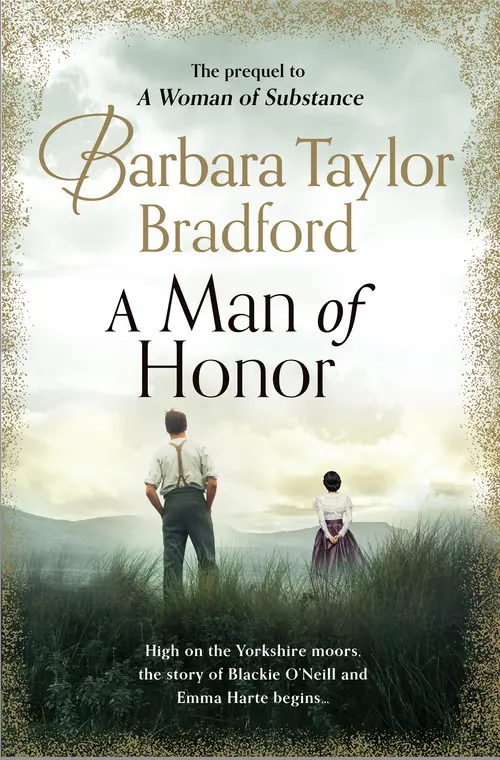
A Man of Honor
Copyright Notice
The author and publisher have provided this e-book to you for your personal use only. You may not make this e-book publicly available in any way. Copyright infringement is against the law. If you believe the copy of this e-book you are reading infringes on the author’s copyright, please notify the publisher at: us.macmillanusa.com/piracy.
Dedication
To the memory of my beloved husband,
my darling Bob. Always my joy and
inspiration and in my heart forever.
Part One
FLIGHT OF THE EAGLE
NORTH KERRY, IRELAND
1899
One
It was very windy on the top of the cliffs. He hadn’t expected that, to be sure. And it was a strong wind that buffeted him forward. It was as if two strong hands were pushing him. Mighty hands at that.
He staggered and flayed about, and attempted to stay upright. Somehow he managed to do so, but he was suddenly afraid. The cliff top was a dangerous place to be on this cold morning.
It was Monday, May the eighth, in the Year of Our Lord 1899, yet despite the month, the weather was icy. What bad luck he had in choosing to come here. Daft, I am, he thought, that’s a certainty.
His bright mind was racing, as he continued to be battered about, and so he threw himself on the ground, deeming it the best place to be as this gale raged around him.
Once down on the ground, he began to crawl across the grass, heading for the formation of boulders grouped together. He knew these cliffs well, and there was a crevice between them. He could squeeze in there and be protected until the wind settled down or disappeared. If I be lucky, he thought miserably.
It was some relief when he reached the rocks and managed to get comfortable in the crevice. Sitting back, he pulled his overcoat around him and stuck his hands in his pockets. Although he was still shivering, being sheltered from the wind helped. He warmed up a bit.
His name was Shane Patrick Desmond O’Neill, but the whole world called him Blackie. He lived in a hamlet in North Kerry, these days with his cousins Michael and Siobhan O’Brien. They had invited him to come and live with them in their cramped thatched cottage after his sister, Bronagh, had died a few months ago.
The twins were employed by the wealthy Anglo-Irish Lassiter family, who lived in the mansion up on the hill above the hamlet. As Shane huddled against the rocks, his thoughts stayed with his cousins.
Michael was a gardener and Siobhan a housemaid. They were not paid very much; he knew that only too well, sure enough he did. Yet they managed better than their neighbors. He mentally hugged them to himself, because they were so caring of him in his time of dire need. His heart ached for his sister—his whole family. They were all dead now. Killed by this fearful land they lived in.
How he longed to leave this place.… If only he were a bird he could take flight … soar up and away … be free of pain and sorrow.
Blackie’s thoughts shifted to the opportunity he had, and Mrs. O’Malley. She was very kind to him. She mothered him and had taught him to read, far better than he had. She was the housekeeper for the local priest, Father O’Donovan. Both kept an eye on him and were now helping to plan his trip … a different future for him, if his uncle Pat could arrange everything. I know he’ll pull it off, Blackie decided. As usual, Blackie was full of optimism, a useful trait, he often thought. Keep smiling was his motto.
He had been inspired by Father O’Donovan’s confidence and filled with excitement about going to England, as thousands had before him. There was no work here, no opportunity for him to earn a few pennies. Even the grown men had no jobs.
The idea of adventure and opportunity overseas was fed by his proximity to the mouth of the river Shannon and the wild Atlantic Ocean beyond.
The wind had finally died down, gone out to sea. Blackie pushed himself to his feet. Stretching, and then pulling his coat around him, he headed for the edge of the cliffs.
He stood gazing out at the rolling waves tipped with white foam, felt as if the sea were calling him across the waters. In his imagination, he envisioned freedom from hardship, poverty and loneliness. He was impatient to be gone, could hardly wait for the day he would leave Ireland from the port of Queenstown. It was usually tough, even harsh, to cross this dangerous sea. Some did not survive the journey, so he had heard, and he believed it to be the truth.
Blackie knew he would. He would will himself to survive, in order to meet his uncle Pat in Liverpool, from whence they would travel on the train to Leeds. He had never been on a train before in his life; the idea of this intrigued him. His uncle had a good business in Leeds, repair work and building for the millowners and even some householders nowadays. He would teach Blackie everything he knew and make him a partner. One day.
Turning away from the roiling ocean waves, Blackie walked back toward the hamlet, his mind settling on the book he had just finished. Father O’Donovan had lent it to him. It was a book about the Tudors, an English royal family from the past.
Blackie loved history, churches and cathedrals. History fed his keen mind; churches and cathedrals fired his ambition to be a builder, a constructor of wonderful buildings. Elizabeth I had been a brilliant queen, a queen who had built a country to become its very best, better than ever before.
He smiled to himself, wishing he had lived then. Suddenly he thought of the Spanish Armada, which had foundered on the Irish Sea, in front of the dark eyes of the Queen herself. She had been wearing a silver breastplate and was mounted on a white stallion, waiting on Plymouth Hoe for her greatest enemy, King Philip of Spain.
Blackie laughed out loud as he thought of this long-ago event, his brain focused on the Queen. He was positive she had been well aware that the harsh wind, which had unexpectedly blown up, had pushed those great Spanish galleons away from the shores of her beloved England. There was no invasion of her land after all.
Her enormous victory had been called an Act of God by the people. He bet she had known the ships had capsized because of a change in the weather, and not Divine Intervention. She was too clever to miss that. A wry smile flickered. The vagaries of the weather were powerful; he knew that.
Black Irish, that’s what I am, so called because of my black hair and dark eyes, he thought, as he contemplated those Spanish sailors of the Armada who had made it to the shores of Ireland and lived. Hundreds had stayed and married the beautiful Irish girls.… He truly was descended from them and proud of it. Sure and he was, very proud.
Blackie was tall for his age and well built, with a wide chest and broad shoulders even at thirteen. He had an inbred sense of purpose, which gave him a certain self-confidence, even an air of authority. It would be the underpinning of his life, a blessing.
This young man who had known much sadness, had grieved for his father and mother, Niall, his brother, and finally his sister, Bronagh. They were all buried next to one another in the church cemetery … buried in the earth they had been the victim of … killed by hunger and grinding poverty.
He sighed under his breath as he walked on. He genuinely understood that life was hard. Mrs. O’Malley had told him that many, many times, and he had already experienced unendurable pain and sorrow.
It had been terrible to lose first his da, then his mam and Niall. He and Bronagh had tried to keep going for a year after that, but after Bronagh’s death he had vowed to himself that he would make his life different, whatever he had to do to attain this. Mrs. O’Malley constantly called him the poor wee bairn under her breath. That was how she saw him. Yet he knew he would grow up to be strong, a man of steel. He understood he could erase the past, create a new future for himself. Who could stop him? He had the time. He was just thirteen.
The drizzle started as Blackie was walking down the dirt road that led into the little hamlet where he had been born and brought up. “Just my luck,” he muttered under his breath, and started to run.
The drizzle became rain and, in seconds, it was a downpour. He was wet through as he jogged ahead, his eyes fixed on the first cottage at the edge of the hamlet. That was where Mrs. O’Malley lived.
He glowered at the leaden sky. Thank God for Mrs. O’Malley, he said to himself. She will come to my rescue. As she had many times.
He slowed down as he entered the hamlet. Within a minute, he was coming to a stop at her cottage. He was not a bit surprised to see Mrs. O’Malley herself standing on the doorstep in front of her open door, a look of expectancy on her face, worry in her eyes.
Two
“Well, just look at yerself, standing there, dripping rain and on me clean floor, Blackie!” Mrs. O’Malley exclaimed, after she had beckoned him into her cottage.
Blackie, looking down at his feet, murmured, “Very sorry, Mrs. O’Malley, swear I am. If ye give me a cloth, I’ll clean it up.”
“Nay, come on, lad; I can do that. Take yer coat off, and then yer boots. That’s how a lad gets a cold, standing around in wet shoes, ye knows.”
Moving toward him, she took his coat, which was soaked, and carried it to the sink. After laying it across the top, she went for his boots.
“Go and sit near the fire,” she instructed, “while I stuff newspaper in yer boots. Best thing there is for helping to dry ’em.” She didn’t say that they wouldn’t survive if she didn’t, as cracked and worn as they were.
“Thanks, Mrs. O’Malley, for looking after me like this.”
“Been doing it all yer life, lad, to my way of thinking. Best take yer socks off as well.”
Mrs. O’Malley spoke the truth. Ever since Blackie had been born to Ellen O’Neill and her husband, Mick, she had been on hand to help them. He was their youngest child, and Ellen was already run-down, exhausted by housework, cooking and looking after her family.
Martha O’Malley was glad to help. She had been widowed several years when Blackie arrived on their planet. Her own son, Dennis, had been eight years old. He was her only child and her joy in life. Dennis had grown up well, and, now at the age of twenty-one, he lived and worked in county Cork, where her sister Agatha Nolan and husband, Jimmy, had a small shop selling groceries in the busy port of Queenstown. Childless, and also fond of their nephew, they had taken him under their wings. Dennis worked in their grocery shop. He enjoyed his job and his life there.
Mrs. O’Malley put the stuffed shoes on the hearth and turned to Blackie. She reached for the wet socks and placed them next to the shoes. Straightening, she turned to Blackie and said, “Now, how about a cup of nice tea? It’ll warm the cockles of yer heart.”
“Faith and it would,” he responded, and flashed her a wide smile.
She smiled back and felt a small rush of pleasure. There was something special and endearing about the boy. Everyone felt his warmth and friendliness and was drawn to him immediately.
His geniality was part of his natural personality, and he spoke to everyone, radiated kindness. These traits never varied, and his dark good looks played into the attraction he exuded.
After taking the bubbling kettle off the hob, Martha O’Malley filled her brown teapot with tea and then poured in the water. She left it to mash for a few minutes. She went to the larder and took out the biscuit tin, well aware Blackie liked her sweet oat biscuits.
The two of them sat in front of the roaring fire, silent, lost in their own thoughts, comfortable with each other. This easiness between them came from the longevity of their friendship, the middle-aged woman and the young boy. They understood each other perfectly.
Martha O’Malley was pondering Blackie’s clothes. The dark coat, drying now, hanging on a chairback near the fire, was threadbare and looked as if it had seen better days. And his boots, drying as well, were in poor shape, but just about held together at the moment. Fortunately, the heavy-knit fisherman’s jumper was one she had knitted years ago for her son.
As for the long trousers, they were a pair Lady Lassiter, from the big house, had given to Blackie’s cousin Michael. They had been too big for him, but they fit Blackie well. As if made to measure, Mrs. O’Malley thought, her mind focusing on Lucinda, wife of Lord Lassiter, the Earl of Harding, who lived in the big house on the hill above the hamlet. Her Ladyship was often found giving away cast-off clothes no longer used and worn by her children or even sometimes Lord Robert. Blackie had been the beneficiary of her gifts, and before him, Mrs. O’Malley’s son, Dennis, had received handouts, along with some of the younger village children.
The Lassiters were an Anglo-Irish family with ancient roots in Ireland. Ancestors of Lord Lassiter had built the large house on the hill two centuries ago, and it had stood fast and strong for all these years.
Lady Lassiter had been born to English parents, herself the daughter of an earl. Her maiden name had been Lucinda Harley, with the honor title of Lady. Her parents, who had been staying in Ireland when she was born, were Lord and Lady Harley, the Earl and Countess of Carlton. They lived in Skipton most of the time.
Drawn to their daughter’s birthplace, Lady Lucinda’s parents had brought her often to the Emerald Isle. One day she met Lord Robert and a glittering match was made, though Mrs. O’Malley didn’t think there had been much love involved. Now they divided their time between England and Ireland, with Lady Lassiter seeming to prefer the Irish mansion.
“What are ye thinking about?” Blackie said, touching Martha’s arm.
Startled, she jumped slightly, and then gave him a loving look. “I was brooding a bit, my lad, thinking how much I would miss ye once ye’d gone off ter join yer uncle Pat—”
“I’ll miss ye,” he answered, and looked at her intently. “Mam always said ye were like a second mother to us all, faith and she did, and ye were. ’Tis the truth, Mrs. O’Malley.”
“Well, yer mam is always yer mam, but I did enjoy looking after ye all, sure and I did, and I’m proud of ye, Blackie. What a grand lad ye’ve become, and handsome.”
A blush spread across his face and he mumbled, “Oh, I don’t know about that.”
Martha O’Malley said in a low voice, “Has Lady Lassiter given Michael any castoffs for ye, lad?” Her eyes were on his.
He nodded. “I’m getting an old overcoat, a jacket and another pair of trousers, so Michael told me. She’s generous, Her Ladyship is, and I’m grateful, sure and I am.”
A smile spread across Mrs. O’Malley’s face. “I have a surprise for ye. I’ve knitted two jumpers for ye and I found a bag of Dennis’s socks that will do ye well.”
Blackie laughed and exclaimed, “I’ll be the best-dressed lad in Leeds, won’t I?”
Mrs. O’Malley laughed with him, and then glanced at the small clock on the mantelpiece as it struck twelve. “Goodness me, it’s already dinnertime. I hope ye’ll stay and have a bite with me, Blackie; sure and I would enjoy that.”
“If yer sure that’s all right,” he said quietly, knowing it was. They often had dinner together, and she always invited him if she ran into him. With his cousins at the big house all day, she knew he’d go hungry otherwise.
“’Tis indeed,” she answered, the Irish lilt in her voice apparent. “It’s always been awright with me.… Ye see I love ye like my own lad, Shane Patrick Desmond O’Neill, known as Blackie to the whole wide world.”
Three
The kitchen was warm, cozy and quiet. Blackie sat back in Mrs. O’Malley’s chair, relaxed, even a little sleepy, as he gazed into the roaring fire.
The flames flaring and rising up the chimney were vividly pink, gold and deep red. And in them he saw his dreams reflected: this trip to Queenstown, the sea crossing to Liverpool and the long journey on the train to Leeds.
That city flickered within the flames, many images. A great metropolis it was: his uncle Pat had explained that in his last letter. He had told him the streets were paved with gold, there were jobs aplenty, and work for everyone who wanted to make money. The right place for him.
MONEY. That word loomed large in his mind. Money made you safe, less vulnerable to the grasping world surrounding you, especially if you were a young boy like he was. No, he now thought, I’m not a young boy. I am thirteen, and thanks to my height and strong build, I look much older—sixteen or so at least.
This happened to be the truth. Unlike his brother, Niall, and sister, Bronagh, he was a grand specimen of a young man and extremely good-looking. His siblings had been so much slighter and shorter in height. They had teased him, called him the giant and just laughed.
The luck of the draw, he thought, sure and it is. Blackie was well aware he could win in a brawl. He’d knock a man out with one punch. He’d tackle a small group if they came after him intent on trouble. Once his uncle Pat had come to visit from England, and had said he ought to step into the ring and become a boxer, and that he’d become a champion.
No, not for him. He could not abide violence of any kind and avoided confrontations like the plague. His ambitions were to work hard with his uncle and to learn to be a builder. He didn’t just want to repair houses. He wanted to construct houses, even design them. He had the talent. He knew that.
He smiled inwardly and saw the house of his dreams hidden in the bright red flames. It was large and square, with three floors. When he built it one day, it would have tall windows, high ceilings and a fireplace in every room, even in the bedrooms. His feet were always cold and so he loved fires.
He glanced down at them now, encased in a pair of Dennis’s socks. They were warm wool socks that Mrs. O’Malley had given to him earlier. She was so good to him, faith and she was, a loving woman.
She dropped a spoon and bent to pick it up, turning to look at him as she did. A smile slid onto her face.
“Thanks for letting me stay here after dinner,” Blackie said.
“Ye always can and ye always do,” Martha retorted, a grin replacing the smile.
“I know.” He grinned back. It was a ritual.
She nodded and swung back to the bowl on the table next to the sink. She began to knead the dough, pushing her hands into it determinedly.
He watched her for a while, then asked with a puzzled frown, “What are ye making all that dough for?”
Without turning her head, she replied, “Rabbit pies. Two rabbit pies.”
“Are ye really?” He couldn’t help wondering where the rabbits had come from. He said, “Who caught the rabbits for ye, Mrs. Martha?”
He often called her that, because her first name on his lips made him feel she was family, which she was in his opinion. For all his life, in fact.
“Joe O’Donnell did me the big favor. Ye see he tries to help me when he can. He found ’em in a warren near the edge of yon woods. Trapped ’em and carried them over.”
Blackie nodded, then exclaimed, “I hope ye didn’t have to skin ’em!” He pulled a face.
She shook her head and smiled. “I know yer a bit … squeamish, lad. Though you won’t be when it’s yer next meal. But Joe saved me the job. He brought ’em last night, skinned ’em right here at this sink and wrapped the skins in an old piece of sacking, sure and he did. Then I washed ’em with salt and put ’em away in yon cold room.” As she spoke, she indicated the larder across the room.
“When will they be cooked? Are the pies for tonight?” He knew he sounded eager, but he was hungry again.
The Story Continues on BooksBarbecue!
Enjoyed this preview? ❤️ Do not stop here!
Read the complete book free online → 🔗
Continue reading now on BooksBarbecue and discover every page!
Love reading? Bookmark BooksBarbecue.com for more amazing books!
Happy Reading!