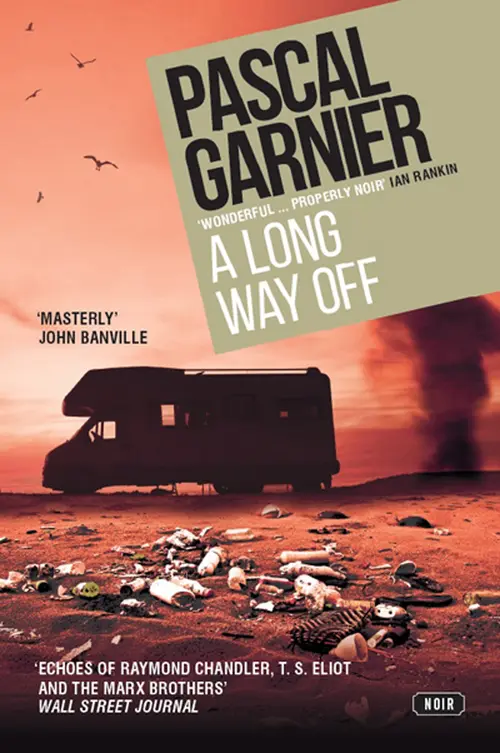
A Long Way Off
Cover
Pascal Garnier was born in Paris in 1949. The prize-winning author of more than sixty books, he remains a leading figure in contemporary French literature, in the tradition of Georges Simenon. He died in 2010.
Emily Boyce is an editor and in-house translator at Gallic Books.
‘Wonderful … Properly noir’
Ian Rankin
‘Garnier plunges you into a bizarre, overheated world, seething death, writing, fictions and philosophy. He’s a trippy, sleazy, sly and classy read’
A. L. Kennedy
‘Horribly funny … appalling and bracing in equal measure. Masterful’
John Banville
‘Ennui, dislocation, alienation, estrangement – these are the colours on Garnier’s palette. His books are out there on their own: short, jagged and exhilarating’
Stanley Donwood
‘Garnier’s world exists in the cracks and margins of ours; just off-key, often teetering on the surreal, yet all too plausible. His mordant literary edge makes these succinct novels stimulating and rewarding’
Sunday Times
‘Deliciously dark … painfully funny’
New York Times
‘A mixture of Albert Camus and J. G. Ballard’
Financial Times
‘A brilliant exercise in grim and gripping irony; makes you grin as well as wince’
Sunday Telegraph
‘Bleak, often funny and never predictable’
The Observer
‘A master of the surreal noir thriller – Luis Buñuel meets Georges Simenon’
Times Literary Supplement
‘Small but perfectly formed darkest noir fiction told in spare, mordant prose … Recounted with disconcerting matter-of-factness, Garnier’s work is surreal and horrific in equal measure’
The Guardian
‘A jeu d’esprit of hard-boiled symbolism, with echoes of Raymond Chandler, T. S. Eliot and the Marx Brothers’
Wall Street Journal
‘Brief, brisk, ruthlessly entertaining … Garnier makes bleakness pleasurable’
NPR
‘Like Georges Simenon’s books, Pascal Garnier’s subversive, almost surreal tales come in slim little volumes, seldom more than 150 pages or so. But in that space he manages to say as much, and more memorably too, than many authors of books that are too heavy to hold’
Literary Review
‘Superb’
The Spectator
‘Deliciously sly and nuanced’
Irish Times
Also by Pascal Garnier:
Pascal Garnier: Gallic Noir Volumes 1, 2 and 3
The Panda Theory
How’s the Pain?
The A26
Moon in a Dead Eye
The Front Seat Passenger
The Islanders
Boxes
Too Close to the Edge
The Eskimo Solution
Low Heights
C’est la Vie
A Long Way Off

Title Page
A Long Way Off
Pascal Garnier
Translated by Emily Boyce
Gallic Books
London
Dedication
For Samuel Hall
On est loin des amours de loin
On est loin
‘Madame Rêve’
Alain Bashung and Pierre Grillet
A Long Way Off
‘I know Agen, too!’
The guests froze, staring at Marc, forks suspended. He had spoken so loudly he surprised himself, not having been able to get a word in edgeways all evening. Although, apart from his strange revelation about Agen (an overstatement in any case – he had spent barely a few hours there a decade earlier), he had had absolutely nothing to say. Several times, out of politeness, he had tried to make a casual quip, to join a conversation, any conversation, but his dining companions seemed to be deaf to his voice. They, in turn, had nothing to share besides profound platitudes, but at least seemed able to understand and respond to one another. As Marc tuned in and out of his fellow guests’ exchanges, they began to break down into a senseless hubbub, the mangled fragments of sentences clogging his ears until he could barely make out a single sound. When someone across the table had mentioned the town in the south-west of France, he had grabbed it like a life raft: ‘I know Agen, too!’
The hostess coughed into her fist to break the vast silence that had greeted his booming pronouncement and the dinner resumed to the sound of clinking cutlery, slurping and chewing, forced laughter and incoherent rambling. He did not utter another word until he left, thanking his hostess for a wonderful evening as she gave a strained smile and looked away.
The car smelled of a blend of contradictory scents: pine, lavender, bleach and Maroilles cheese. It was the cheese, accidentally left in the boot, that had started it: Chloé had been forced to empty several cans of aerosol of various kinds in a vain attempt to neutralise its heady aroma. Her profile was outlined like a transfer on the dark window.
‘What on earth made you shout “I know Agen, too!” like that?’
‘I don’t know. I was trying to be friendly.’
‘Friendly? Nobody cares that you’ve been to Agen.’
‘No. Me neither.’
‘You’re being very odd at the moment.’
‘Oh. How so?’
‘Distant, like you’re somewhere else. Is there something on your mind?’
‘Not really. Did I embarrass you?’
‘No. It’s just you shouted so loudly, it was as if you were waking up from a nightmare. Everyone wondered what the matter was.’
‘Sorry.’
‘It’s OK. I doubt we’ll see them again anyway. They’re so bloody boring.’
‘You think?’
‘Don’t you?’
‘Maybe. I expect you’re right. The langoustines were very good.’
He had spent a good hour leaning on the railing of the motorway bridge and would probably be there still had it not begun to pour with rain. Often when driving he had seen people perched above main roads like melancholy birds of prey. The sight of them engaged in this sad and usually solitary activity had always intrigued and sometimes worried him. You could imagine almost anything about them – perhaps they were about to throw themselves off, or their bicycle, since they usually had one propped beside them. What were they looking at? He had vowed to see for himself and was glad to have finally done it. With the roar of engines and the petrol fumes, it was perhaps not as peaceful as, say, watching leaves and twigs being carried along by a river, but it was undoubtedly more exciting. Your head rapidly emptied of thought and the flow of cars put you in a sort of meditative stupor, gradually making you giddy. It must be even better by night, with the headlights. Chloé was wrong. It wasn’t he who was distant but everyone else, all these people speeding towards him out of nowhere only to disappear again in a matter of seconds, swallowed by the shadowy mouth of the bridge.
He was soaked to the skin when he got home. Since he had no reason to go out again, he put on his still-warm pyjamas, dressing gown and slippers. With nothing to do, he decided just to be. He took up his usual spot on the sofa but felt strangely ill at ease. After five minutes, he moved into an identical position in an armchair. That was not right either. He tried a chair, and another, and another, and finally perched on an uncomfortable footstool housing Chloé’s sewing kit. He had never sat here before. The living room looked different from this angle. Though he recognised the furniture, ornaments and pictures on the walls, they looked like copies – very good ones, but imitations all the same. The light coming through the window had changed too, turning the sofa a very slightly different shape and colour. It was as if the whole room were in flux.
Mindlessly, he picked up the magnifying glass Chloé used to count embroidery stitches and inspected the palm of his hand. In the absence of a future he saw a fragment of his past, a small V-shaped scar caused by cutting his hand on a broken window at the age of seven. Then he studied the stripes of his pyjamas, stretched taut over his knees, followed by the cracked leather soles of his slippers. To think people went to the trouble of climbing mountains to look down on the world, when a magnifying glass did the same thing.
The house was reasonably tidy, regularly vacuumed and dusted, but it was astonishing what was hidden between the fibres of the rug – tiny crumbs, fine threads, hairs from body and head, particles of more or less identifiable materials which took on extraordinary proportions through the convex lens of the magnifying glass. It would take days on end to cover this pseudo-Persian expanse depicting everything from turbulent rivers to tropical forests and arid deserts. As he crawled over the carpet, he began to feel as if he were returning from a very long journey. It was his childhood he was tracing, hidden in the intricate swirls of the carpet. He saw it surge from the thread like a spring gushing through a clump of watercress. When exactly had he lost it? We wake up one day and all our toys which were so magical and full of life are suddenly nothing but inert, futile, useless objects …
‘What on earth are you doing crawling about on the floor? Have you lost something?’
‘Yes … no. I wasn’t expecting you till later.’
‘I managed to get out early. You’re already in your pyjamas?’
‘I felt a bit under the weather this morning. I haven’t been out.’
‘Have you called the doctor?’
‘No, I took an aspirin. I feel OK now.’
‘You still haven’t had the flu jab, have you?’
‘I’ll go next week, I promise.’
‘You really should. Now you’re over sixty … Especially in this weather. Everyone in the office has got a cold. It’s a hotbed for germs. I’m drenched. I think I’ll have a nice hot bath.’
‘Shall I make some onion soup for dinner?’
‘Good idea.’
*
The onions were browning in sizzling butter. He poured in a glass of white wine, added water, salt and pepper, turned down the heat and covered the pan. He was dying to tell Chloé about his revelation on the motorway bridge, and how he had rediscovered his childhood amid the patterns on the carpet. But would she understand? No: she would be concerned. He would have to explain. It would take hours, and even then … It was school that had taught him to keep his thoughts to himself. From the first day, he had realised he would have two lives, his outward existence and the inner one he could never share. Chloé appeared with a towel wrapped in a turban around her head.
‘Mmm, that smells good!’
She looked so beautiful with the bath steam rising off her skin. Why couldn’t he tell her about the bridge and the rug? Tears formed in his eyes.
‘What’s the matter, darling? Why are you crying?’
‘It’s the onions.’
‘Sure? Not even a glass?’
‘No, thank you.’
‘Suit yourself. Now, where was I? … Oh, yes! So, Elsa fucked off on that fateful September 11 and thanks to those bastard terrorists I couldn’t even complain about it. Collateral damage, you might say.’
Marc was no longer listening. He saw the words coming out of those fat, tomato-sauce-covered lips, which reminded him of a pair of mating slugs, but he did not understand them. The hideous mouth chewed up sentences and excreted them like droppings. The brasserie was nauseatingly hot. The smell of sauerkraut, fish and cigar smoke, and the snatches of conversation, laughter and waiters shouting orders into the kitchen made the atmosphere so thick you could almost slice it. Looking out through misted, half-curtained windows, he could see umbrellas passing on the grey-blue street.
‘Could you excuse me a minute?’
The stairs leading to the toilets seemed to descend endlessly into the bowels of the restaurant. While he waited his turn, Marc washed his hands. The water was lukewarm and smelled bad. His hair was slicked to his forehead with sweat. The toilet flushed and the door opened.
‘Sorry, excuse me.’
‘It’s fine.’
He couldn’t tell if it was a man, woman or bear who had emerged from the cubicle. He went in, pushed the bolt across and sat down. His hands were shaking on his knees. Despite breathing through his mouth, he could not avoid the wafts of detergent, piss and shit seeping under his clothes and through his skin.
Get out, now!
He pulled the chain, raced back upstairs holding his breath, grabbed his anorak from the coat stand and slipped out of the brasserie like a thief. Not until he was two streets away could he breathe normally again. He didn’t know exactly what he’d just escaped from.
What would Claude think of him? You couldn’t just ditch a friend who had invited you out to lunch. Never mind. He would call him this evening, or tomorrow, or the day after tomorrow. Maybe never.
The roads seemed to be tangled together in a complex mesh, apparently leading nowhere. All that could be said of them was that they had two ends and could be navigated in either direction. Each had a more attractive side where the neon light of the shops spilled onto the wet pavement. He stopped in front of a pet shop selling dogs, cats, rats and birds. Through the window, half a dozen dishevelled-looking kittens were squirming about in straw-lined cages.
Some were scratching their ears, others licking their own arseholes, but none were smiling. He found himself drawn to a particularly fat, fluffy and sluggish cat, whose eyes remained closed and ears flat while the little ones climbed all over him and tussled on his head. Such exemplary indifference would make him the ideal travelling companion for a journey into the abyss.
The shop smelled like a circus, like hot, damp cat litter, a bit like the brasserie. The air was filled with rustling wings, cooing, yowling and yapping.
‘Can I help you?’
‘I’d like that fat cat in the corner, the one sleeping under all the others.’
‘This one?’
‘Yes.’
‘The thing is … he’s getting on a bit. He had an accident. I kept him … out of kindness.’
‘That’s the one I want.’
The woman reached into the cage to pull out the animal, who still did not wake up, and placed him in his hands. He was soft and warm, proof that he was not dead.
‘All our animals are vaccinated and chipped. Even him.’
The cat deigned to raise an eyelid, casting a slit of green at the hand that stroked him, yawned revealing a largely toothless jaw, and curled up again, as if to say, ‘It’s all the same to me.’
‘I’ll take him.’
On the metro, the plaintive meows emerging from the cage drew tender glances from female passengers. Marc knew he had made the right choice.
‘You bought it?’
‘Well, yes.’
‘Were you looking for one?’
‘Not especially. Let’s just say we had a meeting of minds. Do you mind?’
‘No, it’s just … a bit surprising. He’s very fat. What shall we call him?’
He had not thought about that. People gave animals such stupid names, by and large.
‘I don’t know. Do we have to name him?’
‘Of course! Has he had anything to eat?’
‘Not yet.’
‘I’ll get him something. Come here, little chap.’
‘Today, I bought a cat.’
Ten times he had picked up the pen and ten times Boudu had swiped it off the desk again. The pair silently appraised one another like chess players, the cat curled up in a circle of lamplight, Marc haloed with the smoke from his cigar. Boudu (as Chloé had christened him) did not have a particularly playful disposition. He slept, ate and crapped. And sometimes, like now, he climbed up on the desk, nestled under the lamp and stared at Marc with an unfathomably vacant look in his golden eyes. One day, Boudu accidentally knocked the pen off the desk and Marc picked it up. Boudu had just invented the pen game. That flash of inspiration, a fortuitous connection between neurons that usually lay dormant, was still a surprise to Marc. Now the cat never missed an opportunity for a game. Marc was always willing. Despite feeling a twinge in his back each time he bent to pick up the biro, he never complained or gave the slightest hint of annoyance. It was not in his nature.
When his daughter Anne was little and he was feeding her, he had played the same game with a spoon instead of a pen. She too had fixed him with an impenetrable stare, wondering how far she could push him before he gave in; he never did, having no trouble with his back in those days. For years she had tried everything to make him crack, without ever succeeding in shaking the monolithic calm of this father who was as smooth and upright as a wardrobe mirror. She had finally given up at the age of twenty-five. She was now thirty-six. Once a year on her birthday, he went to see her in Wing Four of Perray-Vaucluse Hospital. He did not much like going and she never seemed especially pleased to see him, but neither of them would have missed marking the anniversary of the end of the game. If time allowed, they would go for a walk in the gardens, sit on a bench and stare straight ahead without exchanging a word until one of them got up, signifying there was nothing left to share.
Boudu jumped off the desk with a growl. He had had enough of the game or was hungry or needed a poo. Marc inspected his nails and decided they were too long.
The click of the nail clippers cut through the silence. He swept the clippings into the bin. What if he went to see Anne today? This was not their usual day, and a change in routine might unsettle her. Besides, with this rain, it was not the weather for it. Nevertheless, he put on his coat and armed himself with an umbrella.
‘It’s not your day, Monsieur Lecas. It’s not the 14th.’
‘I know, but I’m not sure I’m going to be able to make the usual day.’
‘Anne’s having occupational therapy. There’s nothing wrong, is there?’
‘No, not at all.’
‘She’ll be taken by surprise. You should have phoned.’
‘Sorry.’
‘Well, since you’re here … I’ll send someone to get her.’
‘Thanks.’
A man in pyjamas was sitting with his legs wrapped around his chair, playing with his fingers, mumbling and drooling. Two nurses could be seen sniggering behind the screen at reception. The recently mopped checkerboard floor was drying in patches and the smell of bleach hung in the warm air. Anne appeared at the end of the corridor. She had put on even more weight. She had inherited a solid frame from her mother, but unlike Édith, who was always dieting to improve her figure, Anne had let herself go. She was wearing a shapeless sweater and black trousers that sagged at the knees. Her slippers made no sound on the tiled floor, as if she were gliding on roller skates. Without saying a word, she sat down beside her father, head bowed, her bobbed hair screening her face.
‘Hello, Anne.’
‘Who died?’
‘No one.’
‘Are you going to die?’
‘It’s not on my immediate to-do list. I’m fine.’
‘So it’s me then?’
‘Of course not! Don’t be silly. I came today because …’
He wasn’t sure why. Because of the pen game he had played with Boudu? ‘Because I wanted to see you. I bought a cat.’
Anne was looking at the man playing with his fingers.
‘How much was it?’
‘I can’t remember … forty or fifty euros?’
‘That’s a lot. Give me a cigarette.’
Marc did as he was asked. Anne lifted her sweater and tucked the cigarette inside her bra.
‘That guy over there kills cats. Birds as well. He says it’s his hands that do it, not him.’
‘Shall we go outside so you can smoke that cigarette?’
They sat under a sort of canopy. Water droplets clung to the edge of the roof, a kind of pearl curtain hanging between them and the gardens beyond. Anne had only taken a couple of drags on the cigarette she was holding, which had now gone out.
‘Have you seen your mother recently?’
‘Yes.’
‘How is she?’
‘She talks too much.’
Édith always had been a blabbermouth. He wondered how time had treated her. Since their divorce twenty years earlier he had only seen her once, when Anne had gone into Perray-Vaucluse. She was as beautiful then, and as much of a pain in the arse, as she had ever been. All he knew was that she was still living alone in the same apartment and worked in the property business. They had never made any effort to get back in touch.
‘You didn’t bring my Rocher Suchard?’
‘I did! Sorry, I forgot. Here.’
The chocolate had melted a little in the warmth of his pocket. Anne got it all over her fingers as she unwrapped it. She shoved the whole thing into her mouth in one go and chewed loudly, breathing through her nose. Marc handed her a tissue.
‘Wipe your mouth and fingers.’
All this achieved was to spread the chocolate further over Anne’s lips. She had the same look on her face as Boudu after lapping up his milk: satisfied, but disappointed it was over so quickly.
‘What time is it?’
‘Almost five.’
‘I’m going back. My programme’s on.’
They parted outside the games room. To avoid getting his cheeks mucky, he kissed his daughter on the forehead. She was the same height as him.
‘I don’t suppose you’ll be back?’
‘Of course I will. I’ll be here on the 14th, as usual. Today was just … a little extra.’
‘Oh. What’s the name of the cat?’
‘Boudu.’
She repeated the word, furrowing her brow, before turning on her heel and disappearing inside the games room. As he left, Marc heard the monotonous pitter-patter of a ping-pong game.
‘Twenty euros isn’t too much, is it?’
‘Not if you like it.’
The Story Continues on BooksBarbecue!
Enjoyed this preview? ❤️ Do not stop here!
Read the complete book free online → 🔗
Continue reading now on BooksBarbecue and discover every page!
Love reading? Bookmark BooksBarbecue.com for more amazing books!
Happy Reading!