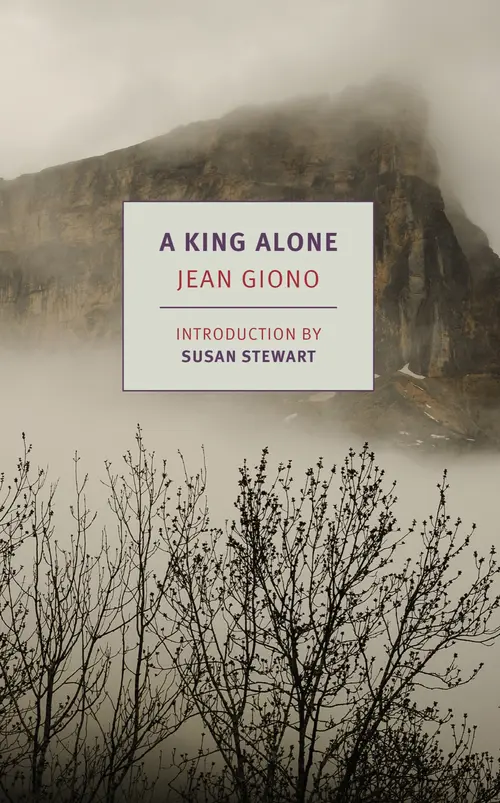
A King Alone
Cover
Biographical Notes
JEAN GIONO (1895–1970) was born and lived most of his life in the town of Manosque, Alpes-de-Haute-Provence. Largely self-educated, he started working as a bank clerk at the age of sixteen and reported for military service when World War I broke out. He saw action in several battles, including Verdun, and was one of only two members of his company to survive. After the war, he returned to his job and family in Manosque and became a vocal, lifelong pacifist. After the success of his first novel, Hill, which won the Prix Brentano, he left the bank and began to publish prolifically. During World War II, Giono’s outspoken pacifism led some to accuse him, unjustly, of defeatism and of collaboration with the Nazis; after France’s liberation in 1944, he was imprisoned and held without charges. Despite being blacklisted, Giono continued writing and achieved renewed success. He was elected to the Académie Goncourt in 1954.
ALYSON WATERS has translated works by Albert Cossery, Louis Aragon, René Belletto, and others. She teaches literary translation in the French department of Yale University and is the managing editor of Yale French Studies. For NYRB Classics, Waters has translated Emmanuel Bove’s Henri Duchemin and His Shadows.
SUSAN STEWART is a poet, critic, and translator and the Avalon Foundation University Professor in the Humanities at Princeton University. A former MacArthur Fellow and Chancellor of the Academy of American Poets, she is the author of six books of poems, including Columbarium and, most recently, Cinder: New and Selected Poems. Her study The Ruins Lesson: Meaning and Material in Western Culture is forthcoming in the fall of 2019.
OTHER BOOKS BY JEAN GIONO
PUBLISHED BY NYRB CLASSICS
Hill
Translated by Paul Eprile
Introduction by David Abram
Melville
Translated by Paul Eprile
Introduction by Edmund White
Title Page
A KING ALONE
JEAN GIONO
Translated from the French by
ALYSON WATERS
Introduction by
SUSAN STEWART
NEW YORK REVIEW BOOKS

New York
INTRODUCTION
ONE SUMMER evening at the turn of the millennium, by the edge of a field near Roussillon, an elderly farmer told me that after the devastation of World War I the local villagers replanted their truffle oaks, knowing they would have to wait at least twenty years for a harvest. But after the devastation of World War II, they despaired of planning and planting, and returned to foraging in the forests with their dogs.
Among those drafted into the Alpine infantry in late 1914 was the twenty-year-old bank clerk Jean Giono, son of an artisan cobbler and a laundress in the Haute-Provence village of Manosque. He emerged more than four years later, “soldat de deuxieme classe, sans croix de guerre.” He had suffered the battles of Eparges, Verdun (where he was one of only a handful of survivors from his regiment), Chemin des Dames, and Kemmel. During a brief interlude in England, where he underwent treatment for gas exposure, he rescued a fellow patient—a blinded English officer—when the hospital caught fire. He was awarded a British medal, his only decoration.
Giono’s autobiographical novel of 1932, Jean le Bleu, ends with this memory: “It was easy for me to go to war without much strong emotion, simply because I was young, and over all young men, a wind was blowing the scent of sails and pirates.” The war left him a fervent, lifelong pacifist, and in 1939 his antiwar activism led to a three-month imprisonment at Marseilles. In 1945, at fifty, he was again imprisoned—this time accused of collaboration with the Vichy government because his writing had been published and his dramas produced during the Occupation. He was placed on a blacklist of writers. At the end of six months, he was acquitted and the public learned of his successful wartime efforts to shelter a number of victims of Nazi persecution.
In September and October of the following year, Giono wrote A King Alone (Un Roi sans divertissement), the story of a remote Alpine village tormented by a serial killer. The novel marks a departure from the pastoral tales of his early career, which were rooted in his love of Greek and Latin literature, and his 1941 homage to Herman Melville, Melville (published in the NYRB Classics series). A King Alone is the first of those novels Giono called his chroniques—designed not so much as histories as layered and unresolved narrations. These were to be “more recounted than written” and A King Alone is assembled from the words of a narrator who is recounting layers of reported speech. This is the technique of legends and of the game we call in English “Chinese whispers”: repetitions inevitably resulting in distortions that open to the wishes and fantasies of even the most certain and rational of speakers. Giono had been reading detective novels from the popular Série noire imprint, and in A King Alone he creates a disconcerting atmosphere of both suspense and retrospection. We readers, like the villagers, are listeners, on edge and searching for clues, assembling patterns, anticipating catastrophes that happened many generations ago and yet continue to hold the villagers in thrall.
The novel’s French title and closing words come from one of the most well-known pensées of Blaise Pascal: Un roi sans divertissements est un homme plein de misères. Pascal explains that a lonely king, with neither sensual nor spiritual resources, will succumb to melancholy, just as any ordinary person who grows dissatisfied with his own room, home, or neighborhood will “go to sea or to besiege a town.” Pascal’s pensée continually haunts this story where events that took place in 1843, ’44, ’45, and ’46 are narrated eighty years or so later against the continuing backdrop of the French colonial war in Algeria. Giono subtly notes that the principal figures here—the police captain Langlois and the café owner and retired prostitute nicknamed Saucisse, which is translated here as “Sausage”—are each in their own way veterans of that war: Langlois in combat with the Algerian tribes led by Abd-el-Kader, Sausage through barracks “service” with its soldiers. The two, who while away the hours together in the café discussing “the ways of the world,” are settlers in, not native to, the village, and they remain objects of fascination for their neighbors. Meanwhile, we follow Sausage’s total preoccupation with Langlois, yet we know very little of Langlois’s own thoughts.
As A King Alone begins, the narrator explains his place in the village and his belated detective work: “I say ‘we’; naturally I wasn’t there because all that happened in 1843, but I had to put my heart and soul into the whole thing and ask so many questions to get to the bottom of it that I ended up being part of it . . .” The narrator and the village remain unnamed, though they are surrounded at no great distance by real places in Haute-Provence: the towns of Chichilianne, Clelles, Mens, Prébois, Chirouzes, and Diois, and the city of Grenoble, the seat of state authority. Yet places less than a day’s walk away might as well be another country, and the village, in its isolation, is bound by iron ties of mutual dependence and kinship. The narrator introduces us at the start to Frédéric, who took over the village sawmill from his father, grandfather, and great-grandfather—all Frédérics. He goes on to recount the genealogies of the village families and their intermarriages. Everyone is known; everyone accounted for.
The murderer, of course, must be a stranger. His initial is revealed to the reader in the opening pages: he will be known only as “Monsieur V.” throughout. The narrator mentions two of the murderer’s legendary predecessors: the eighteenth-century brigands Cartouche and Mandrin, the latter of whom had in his time been known as both “the terror of the ferme générale [the tax collecting agency of the ancien régime]” and a “king.” And he tracks down some of Monsieur V.’s actual descendants. He mentions particularly a young man who is glimpsed reading Gérard de Nerval’s Sylvie in the vicinity of Diois, some thirty kilometers or so distant. If the Algerian allusions and theme of arbitrary violence recall to us the contemporaneity of Albert Camus’s 1942 The Stranger, Nerval’s novella, published in the mid-nineteenth century at the time of his suicide, with its serial love affairs and strong contrasts of color, gives us another example of A King Alone’s own kinships.
Marie Chazottes disappears. The Ravanel son thwarts a kidnapping attempt. And the Ravanel family’s pig is strangely mutilated by a sharp instrument that has been used to carve corkscrew and serpentine shapes into its hide, the sadistic “alphabet of some unknown, barbaric language.” Next Bergues, a skilled tracker who had tried to follow the fleeing kidnapper, himself disappears. The remote situation of the village means that no one wants to venture across the winter landscape to report the crimes to the regional gendarmes—“one had to travel three leagues in solitude.” Nevertheless, a posse departs and fetches six policemen, led by their captain: Langlois. The captain organizes the village to protect itself, but the murderous attacks continue. Each crime is known only by a horrific valence between appearance (blood in the snow) and disappearance (the utterly vanished victims). Langlois has the confidence of the townspeople, but it is Frédéric who will discover the corpses and the murderer. In a heart-pounding sequence of pages, he traces him through the “silence and solemnity” of the snow-covered forests and fields to his house in Chichiliane. Soon Langlois and his fellow policemen will surround the house and lead the murderer to his fate.
The novel’s initial mystery is the motivation of the murderer. The narrator, continuing to think of the family lines of the villagers, suggests that the victims carried within their very blood a certain “liveliness and fire,” and that this “blood was very beautiful. [. . .] Let’s speak like a painter.” He adds a thought about the comparable value of the blood of sets of characters and says,
But then there is another way of looking that includes the first, according to which Abraham and Isaac proceed logically, one following the other, toward Mount Moriah; in which the obsidian knives of the priests of Quetzalcoatl logically drive deep into selected hearts. And it is through beauty that we come to know this. Impossible to live in a world believing that the sublime splendor of the guinea fowl’s plumage is meaningless. Just as an aside. I wanted to say it. I have.
Blood, however, is not an aside. It is everywhere in the novel: in allusions to the bloodlines of the villagers, to Chrétien de Troyes’s Perceval mesmerized by three drops of goose blood in the snow, to the gory evidence of the murders, to the very nickname Sausage—a euphemism for boudin (blood sausage), the disparaging slang term for an aged whore. And yet blood also is pulsing everywhere concealed: beneath human skin and clothing, under the pelts of animals and whatever survives beneath the winter snow.
Monsieur V.’s crimes gradually fade in relation to the story of Langlois’s astonishing response to them, an act that, despite its obviously willed nature, he will claim is “an accident.” This unfathomable action will dominate the remainder of the novel. Langlois will return to the village a year later, in 1846, bearing a new title: commander of the Louveterie (the Wolf-Hunting Corps). His commission places him at the highest rank of those officers, dating back to Charlemagne, who were charged with ridding the French forests of wolves. The villagers are amazed that he has decided to settle among them permanently and suspect he has been disgraced. But his friendship with the respected royal prosecutor and his cordial ties to the officials and upper-class families of nearby towns belie that possibility. In the meantime, he will be preoccupied with the welfare of the murderer’s widow, who has retreated to Diois (where her Sylvie-reading descendant was found). And eventually, disastrously, he will enlist Sausage’s help in finding a wife.
The primary diversion of the bored aristocrat is hunting for pleasure, and in A King Alone, Giono has Langlois organize a highly ceremonial wolf hunt. The ritual aspects of hunting—the music of the hunting horns, the choreography of the parties of men, the trained animals—are starkly set against the spectacle of the kill. Sausage and her friend Madame Tim attend, perched in a sled in their party dresses under warm blankets, and the excited hunters illumine the night with their torches. At the base of a sheer cliff, a true dead end, they will witness “a short, silent, secret meeting between the giver and the receiver of sudden death.” The logic of sacrifice that the narrator had described earlier is linked explicitly to the rituals of communion; the gory serpentine and corkscrew decorations on the slain animals are evoked in the embroideries of the chasubles; and, ultimately, the blood on the snow suggests the writer’s marks on the white page. The ever mysterious Langlois, who states that no man is a monster, is himself a person of what seem to be compulsive repetitions. In the novel’s final pages, we find him literally reenacting the gaze of Perceval, transfixed by drops of goose blood in the snow: soon a third ritualized death will bring the story to a shocking, paradoxical conclusion.
As the reader closes A King Alone, many images will remain: the snow as “thick, frozen dust from a world that must have exploded,” the silent forests, the obdurate mountains. Yet one image will linger in particular: the magisterial beech, standing next to the sawmill, which appears on the first page of the novel. Outliving generation after generation, perhaps a witness to the region’s history of atrocities from the Cathars to modern wars, the tree holds the secret of the serial deaths. Yet it endures beyond them, unharmed. The narrator tells us from the start that the beech is dedicated to Apollo Citharoedus, the lyre-carrying god of order, light, and inspiration. In the end, the great tree invites us to ask ourselves if human beings might share in its powers: “so simple [. . .] it knows itself and judges itself.”
—SUSAN STEWART
Translator's Note
THE TRANSLATOR would like to thank the Banff International Literary Translation Centre for providing a stretch of time and a beautiful environment to begin work on this translation. In particular at BILTC, Paul Gagné and Katie Silver gave me valuable input. In addition, thanks to Donald Nicholson-Smith and Emmanuelle Ertel for putting their heads together with me over some purely Gionesque conundrums. And thanks to Edwin Frank for taking on the editing of this King, making the translation richer and wiser.
—ALYSON WATERS
A KING ALONE
Let us leave a king all alone to reflect on himself quite at leisure, without any gratification of the senses, without any care in his mind, without society; and we will see that a king without diversion is a man full of wretchedness.
—Blaise Pascal, Pensées
(trans. W. F. Trotter)
If you’d send me your bagpipes, and all the other little trinkims belonging to it, I would put them in order, and play some melancholy tunes, well adapted, I might add, to my unpleasant situation as a prisoner.
—Letter from Audl-Reckie
FRÉDÉRIC owns the sawmill on the road to Avers. He took it over from his father, his grandfather, his great-grandfather—from all the Frédérics.
It’s on the side of the road, exactly at the hairpin bend. There’s a beech tree there; I’m sure there’s none more magnificent anywhere. It’s the Apollo Citharoedus of beech trees. There cannot possibly be another beech, anywhere at all, with skin so smooth and so beautiful a color, a more flawless build, more perfect proportions, with such nobility, grace, and eternal youth. Definitely “Apollo” is what you say the instant you catch sight of it, and you say it again and again for as long as you look at it. What is most extraordinary is that it’s both beautiful and so simple. No question about it: it knows itself and judges itself. How can such perfection not have a consciousness, when all it takes is a puff of north wind, an unfortunate shift of evening light, an odd tilt to its leaves for its beauty, defeated, to lose all its power to awe?
•
In 1843, ’44, and ’45, Monsieur V. used this beech quite a bit. Monsieur V. was from Chichiliane, a commune about twenty kilometers from here by a twisted road, at the bottom of a deep valley. No one goes there, they go elsewhere, to Clelles (in the other direction), to Mens, or to countless other places even farther away, but not to Chichiliane. What would a person do there were he to go? What is there to do in Chichiliane? Nothing. It’s just like here. Elsewhere, too, of course; but elsewhere, whether to the east or the west, there can be things to discover, copses, crossroads. Twenty-one kilometers in 1843 was far, just over five leagues, and if you went out it was wearing a smock and boots on a plodding hinny. So Chichiliane was no ordinary destination.
I don’t think there are any V.’s left in Chichiliane. The family hasn’t died out, but there’s no one named V. anymore—neither the café owner nor the grocer—and no one by that name appears on the plaque of the monument to the dead.
There are some V.’s farther along, if you climb up to the Menet pass (the road takes you through masses of greenery in the midst of which you can make out more than a hundred huge or very beautiful beech trees, but none comparable to the beech near Frédéric’s sawmill), if you go down the Diois hillside, well, yes, there you’ll find some V.’s. The third farm to the right of the road, in the meadows, has a fountain with a spout made from two interlocking roof tiles; there are hollyhocks in a small parish garden and, if it’s summer, or even Easter vacation (but then there could still be frost in the vicinity), you might be able to see, sitting at the foot of the hollyhocks, a young man, very dark, thin, with a sprinkling of beard, all tending to exaggerate the size of his eyes, which are already very wide and lost in thought. Usually (well, when I saw him), he reads; he was reading Gérard de Nerval’s Sylvie. He’s a V. He is (well, he was) at the école normale in Valence, or was it Grenoble? And reading Sylvie in that spot is quite odd. You cross under that pass through a tunnel about as “passable” as the former gallery of an abandoned mine, and the Diois hillside on which you emerge up there is a chaotic mix of monstrous whale-blue waves and black jet sprays spurting pine trees onto I don’t know what—an ugly, pinkish rock face, or one that is an insidious gray like the shells of large mollusks; well, the terrestrial equivalent of immense, colliding dark bodies of water that in the midst of a churning cyclone reveal an immeasurable depth. This is why I said that Sylvie, in such a spot, is rather odd because not only is the farm, called the Chirouzes, extremely isolated but its curved walls, its roof, and the way its doors and windows are hidden among huge flying buttresses all make it clear that it is afraid. There are no trees around. All the farm can do is hide in the ground and it’s plain to see that it’s doing just that with all its might: the pastureland behind is higher than the roof. The parish garden is there, just off to the side, fenced in by wire, I believe, and the hollyhocks are there, who knows why, and V. (Amédée), the son, is there, in front of it all. He’s reading Sylvie, by Gérard de Nerval. He was reading Sylvie by Gérard de Nerval when I saw him. I didn’t see his father or mother; I don’t know if he has brothers or sisters; all I know is that he’s a V., that he’s studying at the école normale in Valence or Grenoble, and that he comes back home during school holidays.
The Story Continues on BooksBarbecue!
Enjoyed this preview? ❤️ Do not stop here!
Read the complete book free online → 🔗
Continue reading now on BooksBarbecue and discover every page!
Love reading? Bookmark BooksBarbecue.com for more amazing books!
Happy Reading!