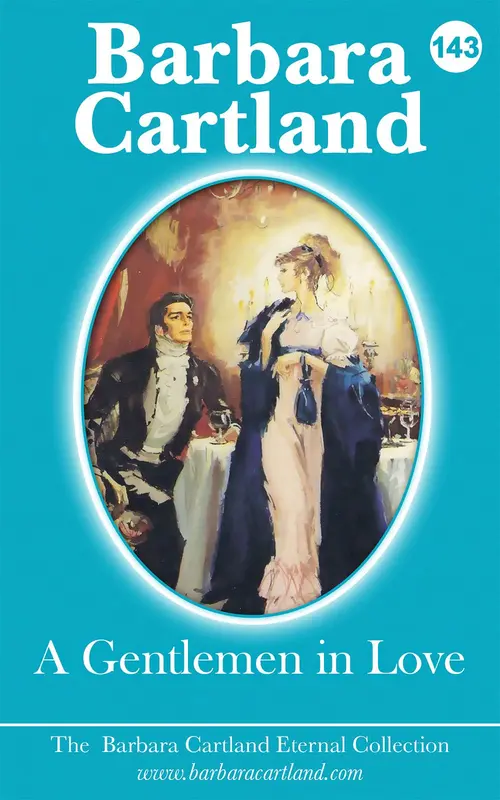
A Gentleman in Love
Author’s Note
Duels of honour were private encounters about real or imaginary insults. Duels with swords spread over Europe from Italy at the end of the fifteenth century. In France political duels were frequent in the nineteenth century and took place occasionally in the twentieth.
In England famous duels were those between Lord Castlereagh and George Canning in 1809 and between the Duke of Wellington and the tenth Earl of Winchelsea in 1829. An Act making duelling a Military affair in 1881 resulted in duels being fought abroad at Calais or Boulogne.
Hatchards bookshop still exists today at 190 Piccadilly.
Chapter One
“I see nothing in this that is remarkable,” the Honourable Richard Rowlands said, inspecting his newly tied cravat from every angle.
“There is a difference, sir,” his valet said respectfully.
“Well, to me it looks just a muddle,” Richard Rowlands responded disagreeably.
“I agree with you,” a voice came from the doorway.
The Honourable Richard swung around with an exclamation,
“Vargus! I did not know you had returned to London!”
“I arrived late last night,” the Earl of Hellington replied, “and I broke my own record, as I intended.”
“With new horses?”
“With the chestnuts I bought at Tattersalls when you were with me.”
“I thought they would prove outstanding,” Richard Rowlands said. “Sit down, Vargus, and have a glass of champagne or would you prefer brandy?”
“It’s too early in the day for either,” the Earl answered, “but I would like a cup of coffee.”
His friend made a face.
“Beastly stuff except when one wants to keep awake.”
“I thought you had more alluring attractions to do that for you,” the Earl remarked mockingly.
He sat down in a comfortable armchair as he spoke and crossed his legs, his polished Hessian boots with their gold tassels shining in a manner that brought a look of admiration into the valet’s eyes as he moved from the room to fetch the coffee the Earl preferred.
Richard Rowlands made no effort to continue dressing, but turned around to sit in his shirtsleeves looking his friend over critically.
“You look damned well!” he said. “I suppose it’s the country air.”
“I have been out in all weathers, training a new horse I intend to win every steeplechase with in the County,” the Earl replied.
“You always do,” Richard said laconically, “and it’s not surprising, considering you always have the best horses because you train them yourself.”
“That is the secret, my dear Richard,” the Earl said. “If you stopped chasing women and concentrated on horses, you would find yourself a better equestrian and very much better in health!”
His friend gave a laugh.
“At the moment the only thing I could afford to train would be a mule that no one else had any use for.”
“Under the hatches?” the Earl asked sympathetically.
“Completely,” Richard replied, “and this time I cannot turn to my father for assistance. He swore to me when I went to him six months ago that he would never bail me out again and, as far as he was concerned, I could stay in the Fleet Prison until I rotted!”
“Strong words!” the Earl remarked, “but, of course, I will see that does not happen to you.”
“No, Vargus. It’s very decent of you to suggest it,” Richard protested, “but you know I swore when we first became friends that I would not sponge on you as three-quarters of your acquaintances manage to do and it’s a vow I intend to keep.”
“It is easy to be proud, if you can afford it,” the Earl said cynically.
“Well, I cannot afford it, but I am still proud.”
“In which case,” the Earl replied, “I hope you will find it edible. I have no wish ever again to be as hungry as we were sometimes with Wellington’s Army. I remember several occasions when I was so empty I would gladly have eaten my boots.”
“I am not likely to forget that,” Richard agreed. “But, if we start talking about the War, I shall forget everything else. Why are you back in London?”
The Earl hesitated and his friend looked at him in surprise.
Ever since they had served in the same Regiment they had been such close friends that Richard believed they had no secrets from each other.
When the War was over, they both turned spontaneously to the gaieties of London as a relief from the privations and discomforts they had suffered in Portugal and Spain.
Even so, when reminiscing, they had found it easier to remember the glory and triumph.
But Waterloo had not only brought the cessation of hostilities with the French, it had also brought young men back into civilian life with not enough to do except seek enjoyment.
This was not difficult in the case of the Earl, who was an exceedingly wealthy man, but dozens of his contemporaries like Richard Rowlands found themselves with a champagne taste, but unable to afford anything but homebrewed ale, unless they were prepared to run into debt.
The Prince Regent had set the fashion for extravagance and the amassing of pile upon pile of unpaid bills, which was being emulated in an alarming fashion by the friends he entertained at Carlton House.
When they were not there, they frequented the Clubs in St. James’s Street.
Here they would gamble with what ready money they could find and discuss the merits of the latest social ‘Incomparable and the fascination of the ‘Impures’, who were to be found in the theatres and the dancehalls at which they were always welcome.
Despite the restrictions imposed upon him by the narrowness of his purse, Richard Rowlands had enjoyed not only the nightlife of London but also the race meetings, the mills, the horse sales and every other event that the beaux and the dandies flocked to daily.
He had thought that the Earl was as fascinated as he was by every new excitement, so he was extremely surprised when three weeks ago he had suddenly for no apparent reason, left London for his country house in Kent.
He gave no explanation on his decision except that he had things to see to in the country.
Richard had missed the Earl more than he would admit and had waited expectantly for an invitation to Hellington Park only to be disappointed.
Now the Earl was back and he said impatiently,
“Come on, Vargus! It’s not like you to be mysterious. If it is a woman who is coming between us, I swear I shall feel like throttling her!”
“It’s not any particular woman, yet in a way you are being clairvoyant, except that the woman you wish to throttle has, as yet, no name.”
“What the devil do you mean by that?” Richard enquired.
As he spoke, his valet came back into the room with a tray on which there was a silver coffee pot, a cream jug and a large man-sized cup.
He set it down on a small table by the Earl who thanked him.
When he left the room the Earl said,
“I went to the country, Richard, to think.”
“To think?” his friend exclaimed.
He spoke incredulously, as if he had never heard of the exercise.
“I thought,” he continued after a moment, “that you were finding Lady Adelaide rather a bore. At the same time that little dancer, what was her name, Fay, was divinely alluring.”
“I paid her off,” the Earl said.
“You got rid of her?” Richard asked. “For whom?”
There was a pause before the Earl replied,
“I don’t know yet, but I have decided that I shall get married.”
“Who is to be the fortunate bride?”
“As I say, I have not yet found her.”
Richard gave a laugh.
“That is just like you, Vargus! You make up your mind about something and plan it out like a military campaign. Well, I think you are wise in your position to marry. It’s obvious that you need an heir, but for God’s sake choose the right woman or it will not be I who will throttle her, but you!”
“That is exactly what I thought myself,” the Earl replied seriously.
He took a sip of coffee before he went on,
“I went to Hellington Park because I felt stifled in London and bored with the endless gambling and drinking and having to toady to all those fat women at Carlton House.”
Richard laughed.
“I agree with you. Lady Hertford ruins one’s enjoyment of the time one spends there, but I am genuinely fond of ‘Prinny’.”
“So am I,” the Earl agreed. “But he has become too pompous lately and far too sensitive about himself. I suppose we can thank Beau Brummell for that.”
Both men were silent for a moment knowing that because Beau Brummell had insulted the Heir to the Throne by calling him ‘fat’, it had made him long avidly for personal compliments in a manner that his friends often found disconcerting.
“Whatever else Prinny is,” the Earl said, “he has excellent taste. In fact it’s outstanding except where it concerns his women! ”
“I believe things were much better when he was with Mrs. Fitzherbert,” Richard replied, “although I am too young to remember.”
“So am I,” the Earl agreed.
“Now, let me think – ” Richard said. “You are just a year older than I am, which means you will be twenty-eight this year. It’s certainly time you married, Vargus. Most men of your consequence are married off almost as soon as they leave Oxford.”
“When I was that age,” the Earl said, “I suppose my choice would have been confined to either a Portuguese peasant or one of those aggressive camp followers who came with the Army. They would hardly grace my table at Hellington Park.”
“That is true,” Richard smiled. “And I have always believed that a wife is a very different kettle of fish from the Ladies of Fashion who have a come hither look in their eyes almost before you are introduced.”
“That is exactly what I think myself,” the Earl said, “and while I know exactly what you are hinting at, Richard, I have no intention of marrying Lady Adelaide or any woman in the least like her.”
There was a smile of satisfaction on Richard’s face as he thought of the dark-haired tempestuous ‘Incomparable’, who had been pursuing the Earl ever since he appeared in London.
She was beautiful and undoubtedly alluring in a serpentine manner that made her the centre of the social scene, despite the fact that she was rivalled by Lady Caroline Lamb, notorious for her mad infatuation for Lord Byron, and a number of other beauties who dispensed their favours very generously on those they fancied.
Lady Adelaide was a widow and had made no secret of her determination to marry the Earl.
If Richard had been surprised at his friend’s sudden disappearance to the country, Lady Adelaide had made no pretence of not being disconsolate.
“Go and fetch him back, Richard,” she said at the last party they had met at and there had been no need for her to explain who she was referring to.
“Vargus will return when he is ready to do so,” Richard had replied defiantly.
Lady Adelaide put her hand on his arm and looked up at him with an expression in her eyes that she knew could send a man crazy with desire.
“Do it for me, dearest Richard,” she said. “You know I would not be, ungrateful.”
For a moment she had almost hypnotised him into agreeing to do anything she asked. Then he had shaken himself free to say,
“I have no more influence over Vargus than you have. If he wishes to return, he will do so. If not, he will stay away.”
It was true that the Earl was a law unto himself.
He was used to commanding and used to being obeyed. Wellington had said that he found him an excellent leader of men owing to the simple reason that he made up his mind what he wanted to achieve and could never visualise for a moment that he would not attain it.
Looking at him now, Richard thought that, while it would be easy for him to get any woman he desired, she would be taking on a very hard task in trying to be the wife he wanted.
For one thing, he would expect perfection and nothing else was acceptable where the Earl was concerned.
Thinking over the women he knew, Richard could not think of one who qualified for that requirement.
As if he realised what his friend was thinking, the Earl said,
“It will not be easy. When I looked at Hellington Park, which has been somewhat neglected since the War, I was aware that it needed a woman’s presence and something else that only she could give it.”
“What is that?” Richard enquired.
“It should be a home,” the Earl said. “That is what it meant to me when I was a young boy and I know that it now lacks what I suppose you could call ‘atmosphere’.”
“I think I understand what you are trying to say,” Richard answered. “I felt the same when my mother died. The house seemed empty.”
“Exactly!” the Earl said. “And also, if I don’t get the heir you suggest, the next in line for the title is an uncle, who is unmarried, and after him another uncle I have never cared for with only four daughters.”
“Good God!” Richard exclaimed. “You will certainly have to get busy to prevent a succession of that sort!”
The Earl drank some more coffee and then said,
“I came back to London to find a pile of invitations waiting for me. There are a number from women who, I believe, are introducing their daughters to Society. I thought you and I might go along to one or two of them.”
Richard gave a groan.
“I cannot imagine anything more depressing,” he said. “Have you ever been to one of those balls where young girls predominate? It is about a thousand times more formal and more boring than Almack’s.”
“That is what I suspected,” the Earl said, “but the only alternative is to ask someone like Lady Melbourne to introduce me to the right sort of young woman. And look what happened to George Byron.”
He was thinking, as he spoke, of how disastrous Lord Byron’s marriage had been and how Lady Byron, now he had gone abroad, was working up a case for divorce with details of cruelty and infidelity that were making the scandalmongers lick their lips.
“I am not going to have that sort of thing happening,” the Earl went on firmly. “I will choose my own wife and I will have no meddlesome interference.”
“She will have to be of the highest breeding,” Richard said. “After all, your mother was the Duke of Dorset’s daughter and no one gives himself more airs than the present Duke.”
He paused and then added quickly in case the Earl should think that he was criticising,
“And quite right. The Dorsets were never part of the Carlton House set. At least that is what my father told me.”
“It’s true,” the Earl replied, “and I certainly would not allow my mother’s place to be filled by any doxy. At the same time to be truthful I find a lot of my Dorset relations extremely dull. They have allied themselves with the King and Queen and spend most of their time decrying the morals, manners and extravagances of our friend Prinny.”
“And of quite a lot of other people as well,” Richard added, “but that is the sort of background your future wife must come from.”
The Earl put down his cup with a little clatter.
“In books it is always so easy,” he said. “The hero meets the heroine, they fall in love, he turns out to be a Prince in disguise and she is not the ‘goose-girl’, but the daughter of a King.”
Richard drew back his head and laughed.
“Where on earth have you heard such stories?”
The Earl laughed too.
“My first Governess, who used to read to me fairy stories every night before I went to sleep, was an incurable romantic. I suppose because children are impressionable, I remember them when I have forgotten a whole number of other much more important things.”
“You will have to see that your children are brought up from a very early age on historical facts and philosophy.”
“It’s no use telling me what I should do with my children until I have them and before I have children I have to find a wife! Come on, Richard, help me! You are not being very constructive.”
“Ever since I have known you,” Richard replied, “you have always set me impossible tasks. I remember at Eton you used to demand delicacies that were out of season and quite unobtainable within the school bounds. When we were in the Army, I was sent foraging when there was not a pig or a chicken within a hundred miles of where we were camped. And now I have to find you a wife! ”
He threw up his hands and exclaimed,
“Dammit all, Vargus, it’s far simpler to provide you with a dozen doxies of the first water!”
“I can find them myself,” the Earl replied.
“That reminds me,” Richard exclaimed, “I promised to look in on Genevieve this morning. If you have not met her, it is something that should be a definite part of your education.”
“Who is Genevieve?” the Earl asked without much interest in his voice.
“She is the latest addition to Madame Vestris’s ballet at the King’s Theatre.”
“I have met Madame and, although her legs are exceptional, she is too flamboyant for my taste,” the Earl remarked.
He was speaking of the dazzling young actress, who, it had been said, ‘sang like an angel, danced like a sylph and possessed the most shapely legs in the world’.”
“I agree with you,” Richard said, “but Genevieve is different. She only arrived from France about a fortnight ago, in fact just after you left, and she has taken London by storm.”
“I seem to have heard that story before.”
“I know, Vargus, but she really is exceptional. She not only dances well but she also has a charm that does not come off with the greasepaint. Come and meet her and you will see that I am not exaggerating.”
“I will come,” the Earl replied, “if you promise to accompany me to at least two of the balls that are taking place tonight.”
Richard groaned and the Earl added,
“One of them will not be too bad, because it is at Ashburnham House.”
“The Princess de Leivens!” Richard exclaimed. “At least she introduced us to the waltz, even though she has the sharpest tongue that ever graced an Embassy.”
The Earl laughed.
“She is too clever to cause a diplomatic incident, but I often wonder how long it will be before the Russian Ambassador is recalled.”
“He will not be, if his wife can prevent it. The Princess likes England. Or should I say the English.”
Richard rose to his feet as he spoke and shouted for his valet.
“Jarvis!”
The man came hurrying into the room to help him into the exceedingly smart cutaway coat with long tails, which, because it fitted without a wrinkle, had obviously been made by Weston.
“You will find the Princess will be only too willing to assist you in your search, Vargus,” Richard remarked.
There was, as he spoke, a twinkle in his eye as if he knew that he was being provocative.
“I have already told you, I will have no interference from women of any sort,” the Earl replied, “and everything I have said to you, Richard, is, of course, in confidence. If you betray me, I swear I will call you out!”
Richard laughed.
“Since you are a far better shot than I am, it would be sheer murder and you would have to flee the country. After all those years in the Peninsula I suspect you have had enough of foreign parts.”
“I certainly have!” the Earl said fervently. “Quite frankly, Richard, I am glad to be home. But there is a devil of a lot to do.”
He gave a sigh.
“The people I employ have grown old, the estate has been neglected and, because everyone was concentrating on the War, there have been practically no repairs done on the houses, barns, fences or anything else.”
“That should keep you busy,” Richard remarked, “but enough, you are depressing me! Come on, Vargus! Let’s go and call on Genevieve.”
“I am not certain that I feel very friendly towards French women at the moment,” the Earl commented.
His friend laughed.
“Does it matter what her nationality is, as long as she is attractive? And let me assure you that French women, like French wines, are, I find, far more delectable than the English variety.”
Carrying his hat and cane Richard started to walk down the stairs of his lodgings as he spoke and smiling, the Earl followed him.
Outside the house in Half Moon Street there was an exceedingly smart phaeton drawn by two superfine horses, Richard glanced at them with a touch of envy in his eyes before he climbed into the seat beside the Earl.
A groom wearing the Hellington livery released the horses’ heads and, as the phaeton moved off, ran to spring up into the small seat behind the Earl and his friend.
Driving with an expertise that had made him in the short time he had been back in England an acclaimed ‘Corinthian’, the Earl turned into Piccadilly.
A number of people walking along the pavement stopped to stare at the arresting picture he made with the smartness of his phaeton, his horses and, of course, himself.
With his tall hat at exactly the right angle on his dark hair, the Earl drew the eyes of every woman within a small radius and appeared supremely unaware that their hearts beat quicker at the mere sight of him.
If there was one thing he disliked, it was a reference to his looks and he had already threatened to thrash any man who spoke of him as a ‘beau’.
“It is only a fashionable term,” Richard had protested,
“I don’t care! It’s insulting for any man to be called beautiful, or for that matter a “dandy”, and it is certainly not the way I wish to be described.”
Richard had teased him, but had been too wise to use the term himself.
The Story Continues on BooksBarbecue!
Enjoyed this preview? ❤️ Do not stop here!
Read the complete book free online → 🔗
Continue reading now on BooksBarbecue and discover every page!
Love reading? Bookmark BooksBarbecue.com for more amazing books!
Happy Reading!