As I was settling my things on the desk next to Marie, I wanted to smile at her, but her eyes were glued to her worksheet, which was covered with tidy, regular writing, as neat and well-behaved as her socks. For myself, I thought it would be better not to look at either my writing or my socks, because both were shapeless and full of holes. Then I must have gone into a trance, because when I looked down again I found some rough paper in front of me. This is what was on it:
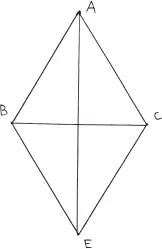
ABC is an isosceles triangle with base BC, therefore AB = AC. E is the reflection of A in the line BC. Therefore AC = EC and AB = EB. EC = AC = AB = EB. ABEC is a rhombus and therefore also a parallelogram. Therefore the image of E after translation is C.
Now here was something that had never happened to me before. I looked around to try and work out who might have had such a kind thought, but nobody caught my eye. It certainly couldn’t have been Haisam, sitting at the back of the class. He’d taken off his big glasses and was gazing at some distant horizon. He looked like an enormous bird that had fallen out of its nest: there was something both fragile and indestructible about him. So then I stopped puzzling over it, because I could do that later, and carefully copied out the answer.
During the break I wanted to ask Marie if she was responsible for the miracle. But I couldn’t find her; she wasn’t the type of girl to hang around in the toilets like the others. I went upstairs to the library. This was more her kind of thing, although I hadn’t really spent any time in there myself yet. On TV once, I’d heard this sort of place called a “temple of culture”. I preferred to keep my distance, on account of the temple and also the culture.
She wasn’t there either. To justify my presence I opened a big dictionary and looked at a random page.
Camellia name given by the botanist Linné in honour of his father Camelli to a shrub with oval, shiny, everlasting leaves and large flowers. The Lady of the Camellias, novel by Alexandre Dumas the younger.