A Firing Offense
Cover
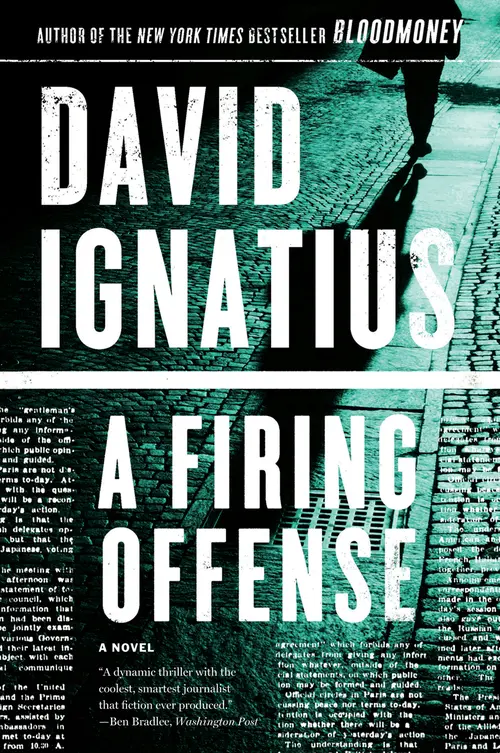
Title Page
DAVID IGNATIUS
A FIRING
OFFENSE
A NOVEL
W. W. NORTON & COMPANY
NEW YORK LONDON
Dedication
Dedication
For my parents, Paul and Nancy Ignatius
Epigraph
Epigraph
Reporters should not ordinarily engage in outside activities and jobs. That is especially true of connections with government, which compromise the newspaper’s fundamental mission of independence and objectivity. Any deliberate violation of this policy will be regarded as a firing offense.
—THE NEW YORK MIRROR HANDBOOK ON STYLE
Prologue
Prologue
A FUNERAL
MAY 1996
Arthur Bowman’s funeral was a Washington event, as finely choreographed as Bowman could have wished. It was held at St. John’s Church, an austere structure across Lafayette Square from the White House. The church was almost full. The vice president was there, along with four members of the cabinet and several dozen senators and congressmen. They were sitting up front near the family, but for once they were the passive observers, and we, the journalists, were the real actors. The whole of the newspaper seemed to have gathered. The publisher and the executive editor and the demigods had flown down from New York, but hundreds of others had come, too—reporters, copy editors, assignment editors, news aides—all the ranks in our newspaper army.
I was sitting in the front row between Edwin Weiss, the executive editor, and Philip Sellinger, the publisher. Weiss had asked me to read something at the funeral. I was the last person from the newspaper to have seen Arthur Bowman before he died in Beijing, and I had accompanied his body back to Washington. The executive editor said it would symbolize continuity at the paper: a beloved colleague departing, the younger generation ready to take over.
As we waited for the service to start, you could hear a low buzz in the church, gaining in intensity as the minutes passed, as people leaned toward each other to share bits of Washington gossip, trade information, discuss the personalities who were there and those who weren’t. By the time the rector rose from his chair and walked to the lectern, the sound was almost a roar.
“‘I am the resurrection and the life, saith the Lord,’” he began, and the buzz of voices suddenly died away. The mourners fumbled in their prayer books for the Order for the Burial of the Dead. Who knew Arthur Bowman was an Episcopalian? That was another of his secrets. I looked over my shoulder at the congregation. All the people I cared about in the world seemed to be gathered under the dome of the church. Several rows back was Annie Baron, my exgirlfriend, already dabbing at her nose with a handkerchief. When she saw me, she tried to smile, but a tear rolled down her cheek. She arched that long neck away from me and, in the same motion, swept a few strands of hair back from her forehead. She was an actress, even in her grief. The rector continued his intonation: “‘We brought nothing into this world, and it is certain we can carry nothing out.’”
There was an overwhelming silence. It was my turn to speak. The rector nodded to me, and I rose and walked to the lectern. I had dressed soberly for the funeral—in a blue suit, white shirt and blue tie—but I suspect I still looked like a California kid: skinny, just under six feet tall, sandy brown hair combed over the top of my head. I was thirty-seven years old; I didn’t yet look damaged or unhealthy enough to be a reporter.
I had expected that I would feel nervous about speaking before so many famous people, but I felt a perfect, unworldly calm. A part of me was still back in China, kneeling over Arthur’s broken body, wiping the blood from his mouth as he gasped for words and breath before he died. The ringing in my ears was the ambulance siren on Chang’an, the Boulevard of Eternal Peace, sent by the men who had murdered him.
Philip Sellinger looked up at me expectantly. There was an odd sparkle in the publisher’s eyes. His best friend had died, but his newspaper survived. I cleared my throat. For that moment I stood on the bridge of this ship of the dead, which was carrying all of us—Arthur and me and our hundreds of colleagues—into our vision of the afterlife. We journalists were the last believers in the god of history. We were its secret priesthood, and though we liked to pretend otherwise, we really did think we were better than ordinary people. We struggled to maintain a divine impartiality, but so often, as in Arthur’s case, we got corrupted somewhere along the journey—caught up in the events we tried to cover.
“For those who don’t know me,” I began, “my name is Eric Truell. I accompanied Arthur to China on his last reporting trip, and I was with him when he died.” I paused. That was enough to say. Any more and I would begin to tell lies. “The Bowman family has asked that I read a favorite psalm, which Arthur had marked in his Bible at home. It is Psalm One Hundred and Two.”
I cleared my throat again and began speaking—slowly, evenly, the way the rector had told me to do. Like so much of Arthur Bowman’s life, the funeral was a form of theater, and I wanted to play my assigned role as well as I could. “‘Hear my prayer, O Lord; let my cry come unto you. Do not hide your face from me in the day of my distress.’” My voice was strong, clear, unreal. People’s faces were turned toward me with attention and expectation. “Incline your ear to me; answer me speedily in the day when I call. For my days pass away like smoke, and my bones burn like a furnace. My heart is stricken and withered like grass; I am too wasted to eat my bread.’”
I had practiced reading the psalm over a dozen times, but until I spoke the words aloud I hadn’t fully understood what a sad, desperate passage it was. The members of the congregation didn’t seem troubled. They mostly had the blank, tolerant looks of irreligious people waiting for the mumbo jumbo to be over. “‘I lie awake; I am like a lonely bird on the housetop. All day long my enemies taunt me; those who deride me use my name for a curse. For I eat ashes like bread, and mingle tears with my drink.’” I stopped for a moment and looked at the audience. I wondered if I was the only one who could hear Arthur’s voice speaking these desperate words. There were a few more verses—happier ones with the boilerplate about God smiting enemies and tormentors—and then I was done.
I returned to my seat. Ed Weiss squeezed my arm as he made his way up to deliver his eulogy. When he reached the lectern, he gripped it tightly on either side and gazed out at the audience. Even at sixty, he was a man of sharp edges—hard cheekbones, a nose that hooked slightly like an Indian chief’s, all that gray hair, swept back on his head—and then the surprise, that lovely, soft smile. He was smiling now, in a way that could only reassure the audience of mourners. This was his flock, more than the rector’s. He removed a written text from his pocket but laid it down, unopened, and began to speak.
“Here is how I remember my friend Arthur,” he began. “It’s a hot afternoon in Phnom Penh, during the height of the war in Cambodia. A group of us have gone to the airport to try to catch a flight out to Thailand. We’re sitting on the floor of the terminal behind the sandbags, smoking cigarettes. Every few minutes, a shell lands near the airport. We’re tired, dispirited, feeling sorry for ourselves. After a while a two-engine plane circles the airport and lands. It’s the weekly flight from Bangkok, the one we’ve been waiting for. They open the door and out walks a guy in a white linen suit—the most beautiful suit you’ve ever seen—carrying a bottle of champagne. And, of course, it’s Arthur. He walks straight across the tarmac, ignoring the screech of an incoming round that lands a few hundred yards away. When he gets to the terminal, he looks at all of us, peering out over the sandbags at him like a bunch of gophers. ‘Hello, lads!’ he says. ‘Don’t tell me you’re leaving.’ He pops the cork and hands the bottle of champagne around.
“Needless to say, none of us left Phnom Penh that day. How could we, once Arthur Bowman had arrived? Our editors would have just sent us back, once his stories began to appear in the Times. I can imagine the cables we would have received from the foreign desk: ‘Times fronting Khmer Rouge massacre. Why we unhave?’” There was a ripple of laughter from the back of the church, where the old-timers were sitting. “There was a lot the Mirror unhad in those days, but we wanted to be a great newspaper. So the first thing I did when I came home to become foreign editor was to conspire with Phil Sellinger to woo Arthur from the Times. It was the best hire we ever made.
“Nobody was a better war reporter than Arthur, because nobody was a better reporter, period. He breathed a story in whole, swallowed it, devoured it. There was something overwhelming about his energy and appetite. It might be after midnight and long past time to go to bed, but Arthur would still be there at the bar, wanting to share one more story, throw down one more drink. You’d stay in bed the next morning until ten trying to sleep it off, and when you finally got downstairs and looked for Arthur, the desk clerk would say he left at seven-thirty to go interview the prime minister—an interview he had somehow forgotten to mention the night before, when he was telling you his life story.”
Weiss stopped speaking and looked up at the perfect white rounded arches of the church, and down at Bowman’s black coffin. He shook his head sadly and muttered something under his breath that sounded like “Shit.” He took a white handkerchief out of his pocket, blew his nose and then continued.
“People told Arthur so many things over the years. Too many things, I sometimes suspect. Especially after he came back to Washington to be our diplomatic correspondent. I look out at the distinguished officials who have come to pay their respects to Arthur, and I ask you: Was there anything that Arthur Bowman didn’t know? Was there any policy position, internal power struggle, or personality clash that Arthur hadn’t heard about? Most of what he knew wound up in the Mirror, where it belonged. Not all of it. But most of it.”
The executive editor smiled. The publisher, sitting two seats away, laughed and shook his head, and other people chuckled, too. That was one thing Arthur was famous for: he knew all the secrets. I seemed to be the only one who didn’t think it was funny, but that was my problem.
“Arthur Bowman was a great man. He deserved better than what he got. To die like that, so far away …” Ed Weiss paused, and I thought he was just catching his breath. But he looked down at the coffin, choking back tears that had suddenly come to him, and put his fist in the air. “Good-bye, dear friend!” he said gruffly, biting his lip to keep from crying any more.
All around the room, people were weeping now. I think I was the only dry-eyed person in the church. But I knew too much.
Philip Sellinger, the publisher, spoke next. He was a thin man, with tightly curled silver hair and those sparkling blue eyes. There was so much emotion in the room, I wondered what he would say. Arthur had been his best friend since college. He had cried on the phone when I called from Beijing with the news. But he was perfectly calm now, talking about his friend as if he were sitting in the next room.
“I would like to share with you a letter Arthur Bowman sent me several years ago,” he began. “I had so many communications with Arthur over the years, but of all of them I think this was my favorite.
“‘Dear Philip,’ he wrote, ‘I hate to bother you about something as trivial as this, but the accounting department is refusing to reimburse me for some expenses on my recent trip to Europe. They seem particularly unhappy about a bill at Mirabelle’s restaurant in London that came to approximately two thousand three hundred dollars.’” He paused, and a few of the mourners began to laugh. “‘Between us, Philip, let me explain what happened. My guests on this occasion were two very senior members of the British Foreign Office and their wives. Because of their immense value to the newspaper over the years, I wanted to show them an especially good time. As always with the Brits, it was the wines that caused the problem. We had a good white Burgundy with the fish course, a Bâtard-Montrachet, I think. And a particularly good claret, a 1982 Léoville-Las-Cases. My guests suggested a Sauternes with dessert, and the inevitable bottle of port, and it all added up. I’m embarrassed that the final bill was so large, Philip, but I don’t have to tell you the importance of maintaining relationships like this. I wish it could be done inexpensively, but good journalism costs money. As ever, Arthur.’”
Sellinger stopped and smiled. By now the whole of the church was laughing. This was a side of Bowman people had gossiped about for years, but rarely discussed. “Here is my esteem for Arthur Bowman,” the publisher continued. “I took the expense form and wrote a note to the accounting department in the margin: ‘Charge this to publisher’s account. Mr. Bowman is worth every penny.’ I’m not sure anyone but me will ever know how profoundly true that was. My debt to him is incalculable. I miss him more than I can say.”
When Sellinger finished, we sang an old Anglican hymn—“Time like an ever-rolling stream bears all its sons away”—and there were some final prayers. They asked the pallbearers to come forward, and we carried Bowman’s coffin to the hearse outside. Ed Weiss took me by the arm after we had laid the coffin in the long black Cadillac and spoke in my ear. “It was like a torch being passed, watching you read that psalm,” he said. “That was my only consolation today.”
We turned back toward the church. It was a spring afternoon, and the air was soft and fragrant. Colleagues from the newsroom were coming toward me, to shake my hand. For the first time all day, I felt like crying. Not for Arthur, but for myself. Looking at this gathering of my dearest friends—all grieving over a man who, they devoutly believed in their hearts, represented the great traditions of our newspaper—I could not imagine ever telling them the truth, about Arthur or about me.
But so much has taken place in the months since Arthur Bowman’s funeral, I realize now that I have no alternative but to tell the story as it really happened. And the truth here will be disturbing to many people.
I: PARIS (MAY–JULY 1994)
I
PARIS
MAY–JULY 1994
1
1
At the time I now regard as the beginning of this story, I was working as the Mirror’s bureau chief in Paris. I had been there two years and I was getting bored. I think that may have been a factor in what happened later. Boredom is ordinarily the fuel of journalism; it is the dry powder that, under the right circumstances, ignites into the flame of curiosity that connects a reporter with his story. We need that burst of energy, because despite what people think, journalism is often quite dull. Reporters spend most of their time waiting for things to happen: for a meeting to end; for one of the cops to give you a fill; for the shelling to stop so you can go outside and see what’s left of the city. And we usually accept the waiting and the passivity; it’s like a launchpad before liftoff. But too much boredom can spark too much heat—creating a passion to connect with the story that is consuming, unbounded, uncontrollable. And I suspect that’s what happened in this case.
It was May 1994, two years before the funeral in Lafayette Square. I was driving to a suburban town east of Paris along the Marne River to interview a French scientist named Roger Navarre. The press spokesman for his company had called me a few days before, claiming that their man had discovered a new technique for regenerating brain cells. He made it sound like a new polio vaccine—something that could cure Alzheimer’s disease, prevent Lou Gehrig’s disease, mend severed spinal cords. Our science editor said it would certainly be newsworthy if true—though he doubted it, since the findings hadn’t been published in any of the U.S. medical journals yet—but he wanted to make sure nobody else scooped us. That’s a strange idea when you think about it—the notion of “scooping” another newspaper about a lifesaving scientific breakthrough—but that’s the way the news business works. At the very least, the science editor said, I would get a nice drive in the country and a feature story about the French biotechnology industry. And I was happy enough to do it; there wasn’t much real news in France that the paper cared about anymore. I had been spending most of my time looking for Lifestyle stories about food and wine and French movie stars—and waiting for a plane to crash or a ferryboat to sink, which would at least get me on the front page for a day.
It was a bright spring afternoon, the kind that reminds you that France is still worth the trouble. And I was on the road, which in itself was a small antidote to my boredom. I had the window of my Renault down—the Paris bureau still had a car, even though we didn’t have any news—and I was sailing along through the Bois de Vincennes, past the tall shade trees that guarded the edge of the park. On the seat next to me was a stack of scientific papers my news aide had gathered, summarizing the latest developments in neurobiology. Forty-eight hours before, I had known absolutely nothing about these subjects. I still knew nothing, really, but over the years I had developed a powerful ability to fake it, if given the smallest amount of raw material. We journalists are skilled impostors; that is one of our trade secrets.
The car radio was on; the French announcer was rattling away the day’s news. Sports scores, the latest from the Balkans, a bulletin about police being summoned to deal with a disturbance in the Rue Lamennais, off the Champs-Élysées. All of it sounded far away. I was driving too fast, which is almost required in France, and I was feeling a sensation I often have when I’m on the way to a story—a sense of possibility, a sense that the familiar is about to give way to the unexpected. The chance of such encounters—even when becalmed on the glassy sea of boredom—was what made my job bearable. That was the game of journalism—waiting patiently for your shot, and then nailing it—and I had always been proficient at games, ever since I was a boy in northern California.
We’re all shaped and misshaped by the experiences of our childhoods. Mine was happy and uncomplicated, which was itself a kind of burden—the burden of lightness. People with emotional scars know they have to be wary; they learn to ration their passions; they know what will hurt them. Nothing in my childhood taught me those lessons. My father was a professor of medicine at the University of California at Davis, and I grew up in the never-again idyll of California in the 1960s and ’70s. We had a big house and a pool, a horse for my sister and a tennis court for me. And what I mostly did until my eighteenth year was to hit tennis balls. Thousands of them, pounding them down the line, crosscourt, forehand, backhand, slice, topspin. Over and over, boom-boom-boom-boom, until I could place a tennis-ball can anywhere across the net and stand a reasonable chance of hitting it. That was how I spent my youth. Haight-Ashbury and its convulsions were over the mountains and into another solar system. I lived in the sun-kissed Sacramento Valley, hitting yellow tennis balls and picking oranges off the trees in our backyard.
The Story Continues on BooksBarbecue!
Enjoyed this preview? ❤️ Do not stop here!
Read the complete book free online → 🔗
Continue reading now on BooksBarbecue and discover every page!
Love reading? Bookmark BooksBarbecue.com for more amazing books!
Happy Reading!